



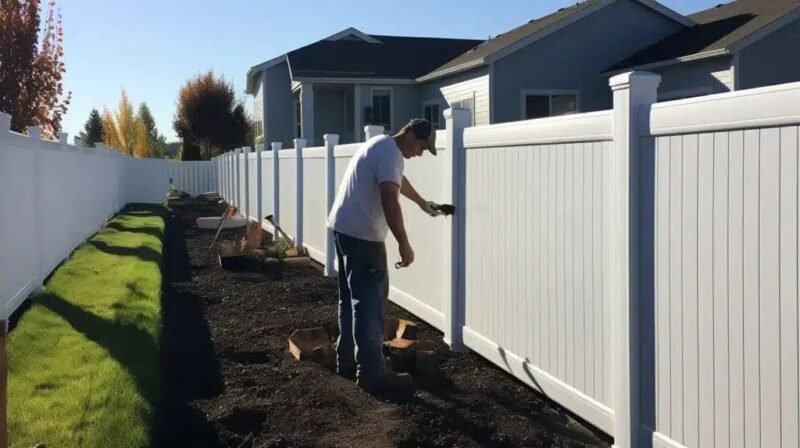
A vinyl fence installs faster than a wood fence and requires no painting, staining, or sealing for the life of the product, note BridgeHaus Property Managers. The posts are hollow vinyl sleeves that slide over pressure-treated 4-by-4 wood posts set in concrete. The rails slot into routed holes in the posts. The pickets slide into the rails. The system is modular and designed for assembly, not fabrication. A 100-foot vinyl privacy fence costs $2,500 to $4,500 in materials and takes two people two to three weekends to install.
The critical difference between vinyl and wood is thermal expansion. Vinyl expands and contracts with temperature. A 6-foot rail can grow by 1/4 inch between a cold winter morning and a hot summer afternoon. If the rails are cut to fit tightly between the posts, they will buckle when they expand. Every connection between a rail and a post must allow the rail to move. The post sleeves, the rail brackets, and the picket spacing all accommodate this movement. Ignore the expansion allowance and the fence will warp within the first year. Here is how to install a vinyl fence that stays straight and does not buckle.
How Vinyl Fence Installation Differs From Wood
Vinyl fence posts are hollow. A 5-by-5 vinyl post sleeve slides over a 4-by-4 pressure-treated wood post set in concrete. The wood post provides the structural strength. The vinyl sleeve provides the appearance and the weather resistance. The wood post is set in the ground exactly as it would be for a wood fence. The vinyl sleeve is placed over it after the concrete has cured. This two-part system means the post can be replaced without digging out the concrete if the vinyl is ever damaged. The sleeve lifts off and a new one slides on.
The rails do not attach to the posts with screws or nails. They fit into pre-routed holes in the post sleeves. The holes are slightly larger than the rail ends to allow for expansion. The rails are held in place by the geometry of the post-and-rail system, not by fasteners. Some vinyl fence systems use internal brackets that clip into the post and hold the rail in position while allowing it to slide. Others use U-shaped channels that the rail rests in. The system is determined by the manufacturer. The principle is the same across all brands: the rail floats in the post, never fixed rigidly.
The pickets slide into holes in the top and bottom rails. The holes are slightly oversized for the same expansion reason. The pickets are not glued or fastened. They float in the rails. A vinyl fence is a system of floating components held together by their own geometry. This is the opposite of a wood fence, where every component is nailed or screwed to every other component. The floating design is what makes vinyl fences durable. It is also what makes them vulnerable to installation errors that restrict movement.
Step One: Plan the Layout and Set the Posts
Call 811 before digging. Mark the fence line with stakes and string. Vinyl fence panels are typically 6 feet or 8 feet wide, measured from post center to post center. The panels are not adjustable. The post spacing must be exact. A post that is 1 inch out of position means the panel will not fit, or the rail will be too short to reach the post, or the rail will be too long and will need to be cut. Cutting a vinyl rail to length is possible but should be avoided because the cut end may not have the same rout profile as the factory end, and the cut end is not UV-protected the way the factory surface is.
Set the 4-by-4 pressure-treated wood posts in concrete below the frost line, following the same procedure as for any fence post. The posts must be plumb, at the correct spacing, and at the correct height. The concrete must cure for at least 24 hours before the vinyl sleeves are installed. For projects near pre-1978 homes, the EPA recommends containing excavated soil due to possible lead paint residue from older exterior paint.
After the concrete has cured, slide the vinyl post sleeves over the wood posts. If the wood post was set plumb, the sleeve will be plumb. If the wood post is out of plumb, the sleeve will follow it, and the fence will lean. The post sleeve must be the correct height so the rail holes align with the rails from the adjacent posts. The bottom of the post sleeve should be approximately 1 inch above the concrete to prevent water from wicking up into the sleeve. Trim the top of the wood post if it protrudes above the sleeve.
Step Two: Install the Rails
Vinyl fence rails come in two types: routed rails that slide into holes in the post sleeves, and bracketed rails that clip into internal brackets. The routed system is more common in residential vinyl fences. The bracketed system is more common in commercial and semi-commercial fences. The manufacturer’s instructions specify which system you have and how the rails connect to the posts.
For a routed system, slide one end of the bottom rail into the hole in the first post sleeve. Slide the other end into the corresponding hole in the next post sleeve. The rail should slide freely in both holes. Do not force it. If the rail binds, the post spacing is slightly off. The rail may need to be trimmed by 1/8 to 1/4 inch to fit. Cut vinyl with a fine-tooth carbide blade in a miter saw or a circular saw. A coarse blade chips the vinyl. Cut slowly. Forcing the cut melts the vinyl instead of cutting it.
For a bracketed system, clip the brackets into the post sleeves at the correct height for the top and bottom rails. The brackets have tabs that engage slots inside the post. Set the rail into the brackets. The rail rests in the bracket channel and can slide back and forth for expansion. The bracket holds the rail vertically and laterally while allowing longitudinal movement.
After both rails are in place between two posts, measure the distance between the posts at the top and the bottom. The posts should be parallel. If they are not, the rails will bind at one end or the other. Adjust the post spacing by shifting the post sleeve slightly on the wood post, if the sleeve tolerances allow it, or by trimming the rail to fit the actual spacing.
Step Three: Install the Pickets
Slide each picket through the hole in the top rail and into the corresponding hole in the bottom rail. The picket should slide freely. If the rails are correctly spaced and parallel, the pickets will align with the holes naturally. If the pickets bind, the rails are not parallel or the post spacing is off.
Vinyl fence pickets are typically tongue-and-groove, meaning each picket interlocks with the adjacent picket along its full height. The interlocking provides privacy and wind resistance. Slide each picket down until its bottom end sits fully in the bottom rail. The top of the picket should extend above the top rail by the amount specified by the manufacturer, typically 1 to 2 inches. The space between the top of the top rail and the bottom of the post cap accommodates the picket tops.
Do not force the pickets together so tightly that they cannot move. The pickets need a small amount of play for thermal expansion the same as the rails do. A fence with pickets jammed together will buckle outward when the temperature rises. The pickets should slide against each other with light friction.
Step Four: Post Caps, Gate, and Final Adjustments
Snap or glue the post caps onto the tops of the post sleeves. The caps prevent water from entering the hollow post sleeve and freezing inside, which can crack the vinyl. Some caps snap into place. Others require PVC cement. Use the adhesive recommended by the fence manufacturer. Standard PVC cement from the plumbing aisle may not bond to the fence vinyl formulation.
Hang the gate. Vinyl fence gates are pre-assembled panels that hang from the gate post using hinges designed for vinyl. The hinges wrap around the post and bolt through the gate frame. The gate must have the same clearance as a wood or chain link gate: approximately 3/4 inch on the latch side and 1/2 inch at the bottom. The gate posts must be set deeper and with more concrete than the line posts because the weight of a vinyl gate, which is heavier than a wood gate of the same size, will pull an inadequately set post out of plumb.
Walk the fence line and check that every rail slides freely in its post holes. A rail that is jammed against the post will buckle when the temperature rises. The movement is small, a fraction of an inch, but the force is large. Vinyl expands with enough force to bend the post or bow the rail if the expansion has nowhere to go. If a rail is tight, remove it, trim 1/8 inch from the end, and reinstall it.
Cutting Vinyl Fence Components
Cut vinyl fence rails and pickets with a miter saw fitted with a fine-tooth carbide blade, at least 60 teeth for a 10-inch blade or 80 teeth for a 12-inch blade. The fine teeth prevent chipping. Cut slowly. Vinyl melts if the blade dwells too long in one spot. Support the full length of the rail or picket on both sides of the cut so the material does not sag and bind the blade. A sawhorse on each side of the saw is the minimum setup.
Cutting vinyl with a circular saw is acceptable for rough cuts in the field where the cut end will be hidden inside a post sleeve. The cut is rougher than a miter saw cut. Use a fine-tooth blade and a straightedge guide. Cut with the finished side up to minimize chipping on the visible surface.
Frequently Asked Questions
Can I use the vinyl post without a wood post inside it?
No. Vinyl fence posts are not structural. The hollow vinyl sleeve has no load-bearing capacity. The pressure-treated wood post inside the sleeve carries the wind load and the weight of the gate. Some manufacturers sell structural vinyl posts with aluminum inserts that replace the wood post. These are used in coastal areas where wood posts rot faster or where the fence is subjected to higher wind loads. For standard residential installations, a 4-by-4 pressure-treated post inside a 5-by-5 vinyl sleeve is the standard assembly.
How do I install a vinyl fence on a slope?
Vinyl fences can be stepped or racked. Stepped installation keeps each panel level and steps the panels down the slope like a staircase. The post height increases on the downhill side to maintain the level panel. The gap under the panel is filled with additional pickets or left open depending on the height. Racked installation angles the rails and pickets to follow the slope. Not all vinyl fence systems are rated for racking. Check the manufacturer’s specifications. Racked installation puts stress on the rail-to-post connections that stepped installation does not. For most residential slopes, stepped installation is the more reliable method.
How do I clean a vinyl fence?
Vinyl fences accumulate mold, mildew, and dirt the same as any outdoor surface. Clean with a garden hose, a soft brush, and a solution of mild dish soap and water. For mold and mildew, add household bleach at a ratio of one part bleach to four parts water. Rinse thoroughly. A pressure washer on a low setting, below 1,500 PSI, can be used for heavy dirt, but keep the nozzle at least 12 inches from the surface and use a fan tip, not a pinpoint tip. High-pressure water forced into the joint between the post and the rail can enter the hollow post and freeze in winter, cracking the vinyl.