





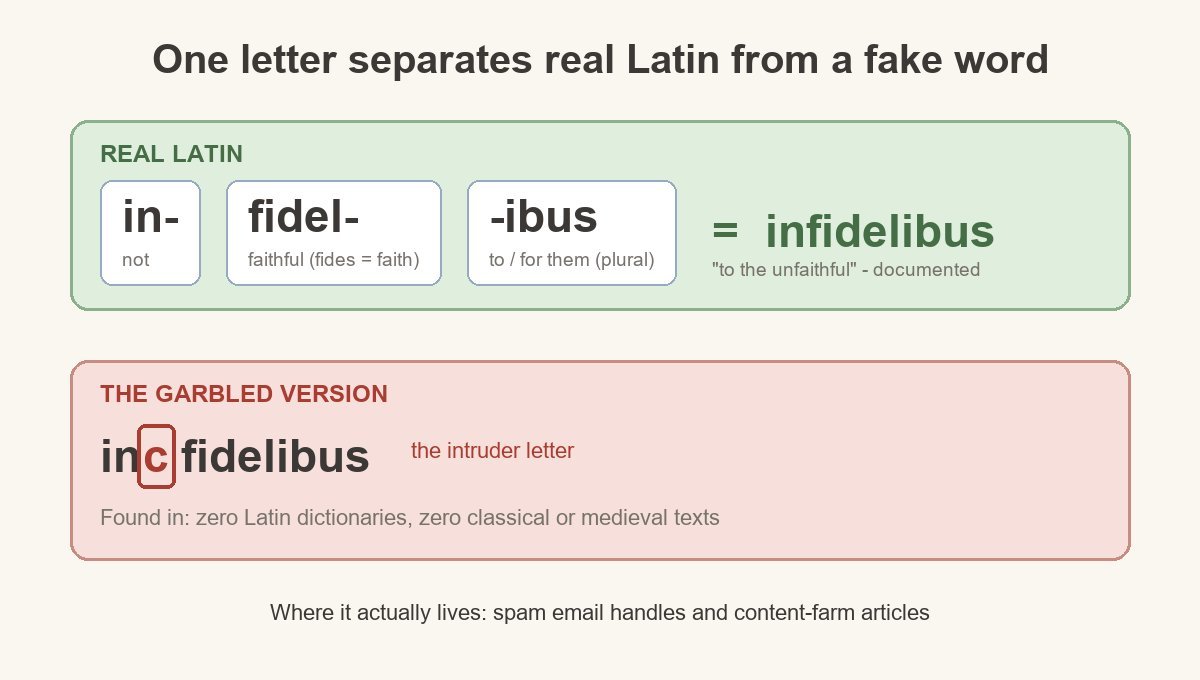
No dictionary in any language contains the word incfidelibus. Remove one letter, though, and you get infidelibus, a real medieval Latin form that scholars have used for centuries.
That single stray “c” is the whole story, and it is worth telling properly. The word you searched for was born from a typo, kept alive by a spam campaign, and then handed a dozen fake meanings by content farms hoping you would click.
This article gives you the receipts for all three claims, plus a practical answer to what most people actually want to know: whether the word is safe to use, and what to do if you met it in a suspicious email or comment.
The Real Word Is Infidelibus
Infidelibus is the dative and ablative plural of the Latin adjective infidelis, meaning unfaithful or unbelieving. It translates as “to the unfaithful” or “among the unbelievers,” and it appears in genuine medieval theological and legal texts.
The word builds from three pieces that any first-year Latin student would recognize. The negative prefix in- attaches to fidelis (faithful), which itself grows out of fides, the Latin noun for faith and trust.
The ending -ibus marks the dative or ablative plural in third-declension adjectives. So a medieval writer describing missionary work “among the unbelievers” would reach for exactly this form.
You can find the parent adjective in any serious reference, including the Wiktionary entry for infidelis, complete with its full declension table. The Church still uses the related phrase in partibus infidelium, “in the regions of the unbelievers,” for bishops assigned to titular sees.
Thomas Aquinas wrote about the status of unbelievers using these forms. Crusade-era legal documents used them to define trade rules and jurisdiction.
None of that heritage transfers to the version with the “c.” Type incfidelibus into a Latin dictionary or a corpus search and you get nothing back, because the form never existed in any classical or medieval text.
Where the Extra Letter Came From
Nobody can prove exactly when the “c” slipped in, but the plausible routes are mundane: a keyboard typo, an OCR misread of an old typeface, or a spammer inventing a unique string. What is provable is that no historical source contains it.
Several articles about the term blame medieval scribes, claiming tired copyists inserted the letter in dim scriptoriums. That theory sounds scholarly but has a hole you could drive a cart through: if scribes had produced this variant, it would survive somewhere in digitized manuscript archives, and it does not.
The OCR explanation is more honest as a possibility. When scanning software reads old print, a stylized long “f” or a tight ligature can register as extra characters, so infidelibus could in theory come out mangled.
Even that is speculation, though, because nobody has produced the scanned page where it happened. The general failure mode of OCR is well documented; this specific error is not.
The simplest explanation fits the evidence best. Someone, at some point, typed the word wrong on the internet, and the misspelling turned out to be useful precisely because it was unique.
A unique string has two modern superpowers. It is always available as an email handle or username, and it forms an empty search results page that low-effort websites can rush to fill.
The Hire-a-Hacker Spam Connection
The main reason people encounter incfidelibus at all is a long-running spam campaign that plants “hire a hacker” comments on blogs and forums, using the word inside contact email addresses. If you found the term in a comment section, you found the campaign.
Anyone who has moderated a blog knows the shape of these messages. They sit in the approval queue between genuine comments, promising to erase criminal records, catch cheating spouses, fix credit scores, or recover stolen cryptocurrency.
The strange Latin-looking handle does real work for the spammer. It passes keyword blacklists that would catch “hacker4hire,” it stays available on every free email provider, and it sounds vaguely like a secret society to a reader who is already primed to believe in shadowy experts.
Here is what happens to the people who write to that address. There is no hacker, only a scammer who asks for an upfront fee, typically a few hundred dollars, then either disappears or invents complications that require more payments.
The cruelty is in who gets targeted. These pitches are aimed at people already in trouble: someone whose job application keeps failing background checks, someone convinced their partner is cheating, someone who just lost savings to a crypto scam and is desperate to claw them back.
That last group gets hit twice. “Recovery hackers” specifically hunt recent fraud victims, taking a second payment from people who can least afford it.
The pool these scammers fish in is enormous. The FTC reported over $10 billion in consumer fraud losses for 2023, the first year past that line, and upfront-fee schemes like this one are a steady slice of it.
The technical premise is fake, too, not just the person. Criminal records live in access-controlled government systems with audit trails and cross-agency backups; nobody deletes an entry for $500, and expungement runs through courts, not Gmail accounts.
If you already paid one of these addresses, stop contact immediately and keep every message as evidence. Report the fraud to your bank or card issuer for a chargeback attempt, then file with the FTC or your local cybercrime unit.
Content Farms Gave It Six Different Meanings
Search the word today and you will find articles confidently defining it as a philosophy of intellectual freedom, a medieval concept, a relationship-infidelity framework, a branding term, and more. These meanings contradict each other because every one of them was invented to fill a keyword.
One survey of the coverage counted six unrelated “definitions” across eight sites, most published within the same month. One site called it “a revolutionary concept” from the heart of medieval Europe; another used it as a synonym for cheating in novels like Anna Karenina; a third recommended it for “usernames, artistic projects, websites, and gaming identities.”
A word cannot be all of those things at once. A real term accumulates one meaning over time through actual use; a keyword vacuum gets stuffed with whatever an article generator produces that day.
The tell is in what these articles avoid saying. Almost none of them state plainly that the word is unattested, because “this word does not exist” is a short article that answers the question and ends the click.
So they hedge. The term “seems to blend traditional linguistic influences with modern cultural ethos,” it is “open to interpretation,” it “resonates deeply.” Vague reverence is the house style of content written about nothing.
This matters beyond one odd Latin string. The same pattern repeats for dozens of manufactured mystery keywords, and once you have seen the mechanism here, you will recognize it instantly elsewhere.
Incfidelibus vs. the Words It Gets Confused With
Three lookalike terms get tangled together in coverage of this keyword, and separating them takes one table. Only one of the three is the word people usually mean, and none of them justifies the spelling with the “c.”
| Term | Status | Meaning | Where you’ll see it |
|---|---|---|---|
| infidelibus | Real Latin (dative/ablative plural) | “To/for/among the unfaithful” | Medieval theology, papal documents, crusade-era law |
| infidelitas | Real Latin noun | Faithlessness, disloyalty; root of English “infidelity” | Classical and church Latin; via French into English |
| incfidelibus | Not a word in any language | None; a corrupted spelling of infidelibus | Spam email handles, content-farm articles |
The romantic-infidelity reading deserves a special debunk because a whole article was built on it. English “infidelity” does descend from fides, but through the abstract noun infidelitas, and in classical usage the word pointed at broken loyalty and broken faith generally, not bedroom betrayal specifically.
Treating incfidelibus as a literary term for cheating stacks two errors: a misspelled word and a misassigned meaning. It is the linguistic equivalent of citing a book that was never written.
Should You Use It as a Username or Brand?
You can, but you probably should not, because the word’s only established association is with hacker-scam spam. A name that moderators and spam filters have seen in fraud pitches for years is a liability, not a mysterious asset.
Some branding-angle articles praise its “strong phonetic rhythm” and guaranteed availability. Availability is real; everything else is a reason it was free.
If you want an evocative Latin identity, the genuine lexicon has thousands of correctly spelled options that will not make you look like a bot.
FAQ About Incfidelibus
What does incfidelibus mean?
It has no meaning, because it is not a real word; it is a corrupted spelling of the Latin infidelibus, which means “to the unfaithful” or “among the unbelievers.” Any definition you see attached to the “c” spelling was invented by content sites.
Is it a valid Latin word?
No. It appears in no Latin dictionary and no classical or medieval text; the cluster “ncf” does not even occur in normal Latin word formation. The valid form is infidelibus, the dative/ablative plural of infidelis.
Is it the name of a hacker group?
No. The word shows up in email addresses used by “hire a hacker” comment spam, but there is no group behind them, only fee-collecting scammers. Anyone who pays those addresses gets ghosted or squeezed for more money, not hacking services.
I got an email or comment mentioning it. What should I do?
Delete it, and do not reply or pay anything, because every known use of this word in outreach is scam bait. Blog owners should blacklist the term in their moderation filters; anyone who already paid should contact their bank and report the fraud to the FTC or local police.
Why does every article define it differently?
Because the definitions are fabricated, and each site fabricated its own. The word is a low-competition keyword with search volume from spam sightings, so content farms rushed out contradictory “explainers” rather than admit the term does not exist.
A Word That Only Exists in Explanations of Itself
Here is the test worth keeping: if a term appears only in articles explaining the term, never in actual use by actual people, that absence is your answer. Real words leave fingerprints in books, conversations, and archives; incfidelibus left none, anywhere, ever.
The internet can now manufacture a mystery out of a typo and sell you twelve solutions to it. The honest solution fits in one line: put the “c” back where it came from, which is nowhere.