



The attic insulation R value you need falls between R-30 and R-60, set by your climate zone. Zone 1 asks for R-30, Zones 2 and 3 ask for R-49, and Zone 4 northward asks for R-60.
Those are targets for a full, unfilled cavity in a wood-framed attic. Real attics rarely match the drawing, and the shortfall traces to how the material was installed, not to the number on the bag.
Two things quietly shrink a working R value: gaps and compression. Both get set on installation day, and both are cheap to avoid once you know what to measure before and after anyone touches the attic.
How Much Attic Insulation R Value You Need
The Department of Energy’s current targets follow the 2021 International Energy Conservation Code: R-30 in climate Zone 1, R-49 in Zones 2 and 3, and R-60 from Zone 4 through Zone 8. These are ceiling values for an attic with no insulation, before air sealing.
| Climate zone | Attic ceiling target | Where it shows up |
|---|---|---|
| 1 | R-30 | South Florida, the Gulf Coast, southern Arizona |
| 2 | R-49 | Louisiana, most of Texas, coastal Southern California |
| 3 | R-49 | Georgia, Tennessee, inland California, Nevada |
| 4 | R-60 | Virginia, Missouri, Oregon, southern Idaho |
| 5 | R-60 | Ohio, Illinois, Indiana, western Washington |
| 6 | R-60 | Massachusetts, Michigan, Iowa, southern Minnesota |
| 7 and 8 | R-60 | Maine, northern Minnesota, most of Alaska |
Which zone is your county in?
The answer comes from the IECC climate map, and plenty of states straddle two of them. A house in western Washington and one in eastern Washington can carry different targets, which is why contractors look up a county rather than a state.
The older ENERGY STAR recommendation gave ranges instead of single numbers. For Zones 5 through 8 it listed R-49 to R-60 as the attic target, and homes built to that reading often settled at R-49. The current table treats R-60 as the cost-effective level from Zone 4 up.
An attic that already holds 3 or 4 inches of older material needs a smaller add-on: about R-25 in Zone 1, R-38 in Zones 2 and 3, and R-49 from Zone 4 northward. Those add-on figures come from the ENERGY STAR recommended insulation levels table, which is built on the same 2021 code.
How Many Inches That R Value Takes
Depth depends on the material, because every type carries a different R-value per inch. Blown cellulose delivers about R-3.5 per inch, loose fiberglass about R-2.5, and closed-cell spray foam R-6 or more, so reaching R-49 takes roughly 14 inches of cellulose but only 8 of foam.
The Department of Energy publishes a per-inch range for each product family, and the spread is wide enough to plan around:
- Fiberglass batts: R-2.9 to R-3.8 per inch
- Loose-fill fiberglass: R-2.2 to R-2.7 per inch
- Cellulose: R-3.2 to R-3.8 per inch
- Mineral wool: R-3.0 to R-3.3 per inch
- Open-cell spray foam: about R-3.6 per inch
- Closed-cell spray foam: R-6.0 to R-7.0 per inch
Run the math for each target and the depth picture lands here. R-30 needs 9 inches of cellulose or 12 of loose fiberglass. R-49 needs 14 inches of cellulose, 20 of loose fiberglass, or 7 of closed-cell foam. R-60 needs 17 inches of cellulose or 24 of loose fiberglass.
That same math audits an attic you already own. Measure the depth in three or four spots, note the material, and multiply depth by the per-inch figure. Eight inches of settled cellulose is around R-28, short of the R-49 a Zone 3 house calls for.
Loose fill also settles on its own in the first few seasons. An attic topped up to the exact target depth can read under that number two winters later, which is one reason installers aim slightly high.
Why the Installed R Value Falls Short of the Label
Compression and gaps cost you R value even when the material matches the spec. The Insulation Institute puts the loss at about half the percentage of compression, so squeezing a batt by 12 percent cuts its total R value roughly 6 percent. A standard R-19 batt, 6.25 inches thick, pressed into a 5.5-inch cavity lands near R-18.
Oak Ridge National Laboratory measured the same effect for the code record: compressing fiberglass to 90 percent of full thickness dropped the material R value between 5.6 and 9.4 percent. One batt rarely sinks a whole attic. Two hundred of them, each a little flat, do.
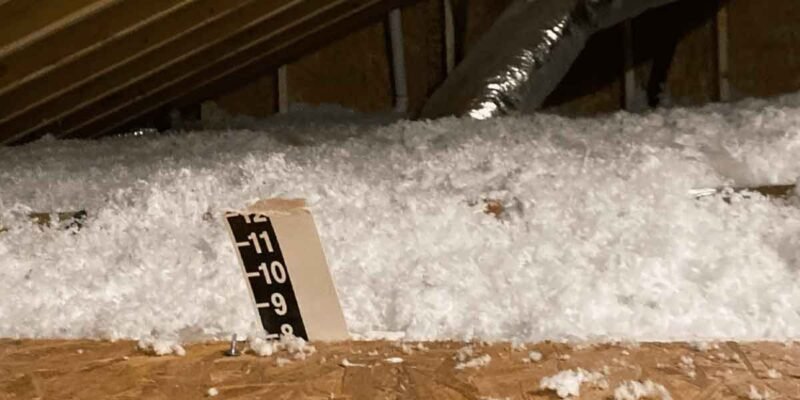
Gaps hurt a loose-fill job more than compression does. The Department of Energy’s attic checklists call for installation with less than 2 percent gaps, voids, and compressions, checked with depth rulers left in place so an inspector can read them later. Fiber insulation is not an air barrier, and a two-inch void around a chimney chase leaks heat that the surrounding R-60 never touches. The same checklist asks for full coverage across the top plate at the eaves, the spot where a low heel truss leaves the least room for material and the most room for a mistake.
Eave vents add a third problem. Air drawn in at the soffit will blow straight through loose fill if nothing deflects it, a failure called wind washing that strips the outer corners of the ceiling. Baffles fix it. They need to reach at least 6 inches above the finished insulation height, not just clear it.
Walk an attic done without baffles and the pattern is easy to read. Dense fill spreads across the middle. Right at the eaves, a clean bare strip of drywall shows where incoming air pushed the loose material back. It looks tidy. It is also the coldest stretch of ceiling in January.
One more gap sits between the lab and the attic. R-value gets measured at a fixed mean temperature of 75°F, and a roof deck in July runs far hotter than that. Foam products shed some of their rating as temperature climbs, so the figure on the bag describes conditions your attic rarely sees.
Seal the Attic Floor Before You Add Insulation
Fiberglass and cellulose do not stop air. The Department of Energy’s weatherization checklists put air sealing ahead of insulation, because a leaky attic floor lets the conditioned air you already paid to cool slip past even a generous layer of fill.
The leaks cluster in predictable places: top plates where interior walls meet the attic floor, recessed light housings, plumbing and electrical penetrations, dropped soffits, and the attic hatch itself. Seal those first with caulk, foam, or rigid covers matched to the opening. A can light that is not rated for insulation contact needs a sealed box over it, not cellulose packed against the housing.
Caulk seals gaps up to a quarter inch. Expanding foam covers anything wider.
A common mistake is assuming the printed R-value already accounts for the installation around it. It does not. Do the sealing first and a mid-range R value often outperforms a higher one sitting on a leak, which shows up months later as a lower winter heating bill.
What the 7-and-7 Rule Measures
The 7-and-7 rule decides whether an attic can become living space, not how much insulation it needs. It asks for seven feet of ceiling height, seven feet of clear width in one direction, and about 70 square feet of floor area that meets that height.
The rule comes from the ceiling-height and minimum-area provisions most states adopt through the International Residential Code, which sets seven feet as the minimum ceiling height for a habitable room. Massachusetts writes it out in 780 CMR, and inspectors there apply a further condition: at least half the required floor area must clear seven feet, and any spot under five feet tall counts for nothing.
Measurements for that test run to finished surfaces, so drywall, subfloor, and rigid insulation eat four to eight inches of headroom before furniture moves in. An attic measuring exactly seven feet at the ridge fails once it is finished.
The rule still bears on insulation in a secondhand way. A finished attic has less room for fill than an open one, since rafters and knee walls leave shallow bays. That is where closed-cell foam earns its price, because R-6 per inch fits a rafter bay that cannot hold 14 inches of cellulose.
Common Questions About Attic Insulation
What is a good attic insulation R value?
A good attic insulation R value is R-30 in climate Zone 1, R-49 in Zones 2 and 3, and R-60 in Zones 4 through 8. The coldest zones carry the highest target because the gap between a heated room and a winter attic is widest there.
Is R-19 or R-30 better in an attic?
R-30 is better for an attic ceiling in every climate zone. R-19 is a wall value in mild zones, and inside a 2×6 stud cavity an R-19 batt compresses to roughly R-18. As a ceiling target it falls short of even Zone 1.
How thick should attic insulation be?
Thickness follows the material, not just the target. Reaching R-60 takes around 17 inches of cellulose, 24 inches of loose fiberglass, or as little as 9 inches of closed-cell foam. Cover the joists completely; bare joist tops mean the layer is thin somewhere.
Does adding insulation help if the attic already has some?
It helps when the existing layer is thin and the attic floor is sealed. Measure the depth first. A layer level with the joist tops is usually under R-30 and worth topping up, while one already at 14 inches of cellulose sits near the R-49 target and the money is better spent sealing the leaks underneath it.