

A furnace that blows cold air out of the registers is a furnace whose startup sequence is failing at one specific point. The furnace does not simply turn on and produce heat. It goes through a precise sequence of events: the thermostat calls for heat, the inducer fan starts, the pressure switch confirms the inducer is running, the igniter glows or sparks, the gas valve opens, the burners light, the flame sensor confirms the flame is present, the blower starts, and warm air flows. Each step must complete successfully before the next step begins. If any step fails, the sequence stops. The blower may run, because it is on a timer or is triggered by a different condition, but the burners are not firing. The air is cold. The question is not just why the furnace is blowing cold air. It is where in the startup sequence the failure occurs.
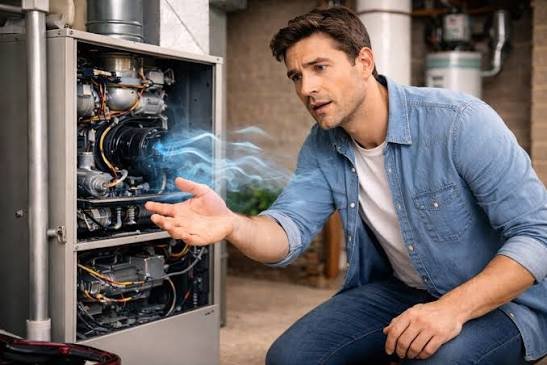
You can diagnose the failure point by standing next to the furnace and listening. Turn the thermostat up to call for heat. Listen for the sequence. Do you hear the inducer fan start? A small fan that runs for a few seconds before the burners light. Do you hear the click of the gas valve opening? Do you see the glow of the igniter through the observation window? Do you hear the burners light, a low whoosh? Do they stay lit, or do they go out after a few seconds? Each sound corresponds to a step in the sequence. The point where the sound stops is the point where the sequence failed. The diagnostic process is simply listening to the furnace try to start and identifying which step it cannot complete.
EPA WaterSense advises that regular maintenance prevents equipment failures. A furnace that is failing to complete its startup sequence often has a component that could have been cleaned or adjusted during a routine service visit, preventing the cold-air emergency.
The Furnace Startup Sequence and Failure Points
Step one: thermostat calls for heat. If the thermostat clicks but nothing happens, the thermostat is sending the signal but the furnace is not receiving it. Check the furnace power switch and the circuit breaker. Check that the blower access panel is fully closed, engaging the door safety switch. If the panel is ajar, the furnace has no power.
Step two: the inducer fan starts. This is a small fan that pulls combustion air through the burners and pushes exhaust out the flue. If you hear nothing after the thermostat clicks, the inducer is not starting. The inducer motor may have failed, the capacitor may be bad, or the control board may not be sending the signal. An inducer that hums but does not spin has a failed motor or a blockage. A technician can diagnose and replace the inducer. The motor costs $200 to $500.
Step three: the pressure switch closes. The pressure switch is a safety device that confirms the inducer is running by sensing the vacuum it creates. A small rubber tube connects the inducer housing to the pressure switch. If the tube is cracked, disconnected, or clogged with water, the switch will not close. The furnace will not proceed. A furnace that starts the inducer and then stops without ever lighting the burners may have a pressure switch problem. Check the tube. Reconnect it if loose. Clear it if clogged. If the tube is intact and the switch still does not close, the switch may be bad or the inducer may not be producing enough vacuum because the flue is blocked. A blocked flue is a safety hazard and requires immediate attention.
Step four: the igniter glows or sparks. If the inducer runs, the pressure switch closes, but you do not see the orange glow of the hot surface igniter through the observation window, the igniter has failed. A failed igniter is one of the most common furnace failures. The igniter is a ceramic element that glows red-hot to light the gas. It is fragile and cracks after years of thermal cycling. A cracked igniter will not glow. The part costs $30 to $60 and can be replaced by a homeowner comfortable with removing the burner access panel.
Step five: the gas valve opens. If the igniter glows but you do not hear the gas valve click open, and the burners do not light, the gas valve is not opening. The gas valve may be defective, it may not be receiving the signal from the control board, or the gas supply may be interrupted. Check that the manual gas valve on the gas line is open, the handle parallel to the pipe. A gas valve that clicks but does not open may have a stuck solenoid. A gas valve that does not click at all may have a failed coil. A failed gas valve should be replaced by a technician.
Step six: the flame sensor confirms the flame. If the burners light and then go out after a few seconds, the flame sensor is dirty or defective. The sensor is a metal rod that sits in the burner flame. It confirms to the control board that the flame is present. If it is coated with carbon or dust, it cannot detect the flame. The board shuts off the gas as a safety measure. Clean the flame sensor with a Scotch-Brite pad or a dollar bill. Do not use sandpaper. Reinstall it. If cleaning does not fix the problem, replace the sensor. The part costs $15 to $30.
High-Efficiency Furnace Specific: Condensate and Pressure Switches
A high-efficiency furnace, 90 percent AFUE or higher, produces condensate, acidic water, as a byproduct of combustion. The condensate drains through a PVC pipe to a floor drain or outside. If the drain is clogged, water backs up into the furnace and triggers a pressure switch that shuts down the burners. The inducer runs. The igniter may glow. The gas valve opens. The burners light briefly and then shut off. The sequence repeats. The clogged condensate drain is the most common cause of a high-efficiency furnace blowing cold air.
Clear the condensate drain. Pour white vinegar into the drain line to dissolve algae and mineral buildup. If the line is accessible, use a wet-dry vacuum to suck the clog out. Check the condensate trap inside the furnace. The trap is a black plastic box connected to the drain. It can fill with debris and prevent drainage. Remove it, clean it, and reinstall it. The trap is designed to be removable for cleaning. A clogged condensate system is the first thing to check on a high-efficiency furnace that starts and then shuts down.
Quick Diagnostic: Check the Air Temperature at the Register
Hold a thermometer in the air stream at the nearest supply register. The air should be significantly warmer than the room temperature, typically 30 to 50 degrees warmer for a gas furnace, 15 to 25 degrees warmer for a heat pump in heating mode. If the air is room temperature, the burners are not firing at all. If the air is slightly warm but not hot, the burners are firing intermittently, the flame sensor is dirty, the limit switch is tripping, or the gas pressure is low. If the air temperature cycles from warm to cold and back, the furnace is overheating and tripping the limit switch, usually from a dirty filter. The temperature at the register tells you whether the burners are firing and whether the heat is reaching the ductwork.
Frequently Asked Questions
Why does my furnace start and then stop repeatedly?
The furnace is short cycling. The most common cause is a dirty air filter causing the furnace to overheat and trip the high-limit safety switch. The burners shut off. The blower cools the furnace. The limit switch resets. The burners relight. The cycle repeats. Replace the filter. If the short cycling continues, check for closed vents, blocked returns, or a dirty blower wheel.
Is the diagnosis different for an 80% furnace and a 90%+ furnace?
Yes. An 80 percent efficiency furnace has a metal flue pipe and does not produce condensate. A 90 percent or higher furnace has a PVC flue pipe and produces condensate. The condensate system, the drain, the trap, and the pressure switches associated with it, are additional failure points on a high-efficiency furnace. The basic startup sequence, inducer, igniter, gas valve, flame sensor, is the same for both. Check the condensate system first on a high-efficiency furnace. It is the most common cause of ignition failure that is unique to that type of furnace.
What if I have an oil furnace blowing cold air?
An oil furnace that blows cold air has a fuel delivery problem, an ignition problem, or a clogged nozzle or filter. Check the fuel level in the oil tank. Check that the emergency shutoff switch, typically a red switch plate at the top of the basement stairs, is in the on position. An oil furnace requires a technician for most repairs because the ignition system uses high voltage and the nozzle and electrodes require precise adjustment. If you have fuel and the switch is on, but the furnace blows cold air, call an oil heat technician.
The Bottom Line
A furnace blowing cold air is failing at one specific step in its startup sequence. Stand next to the furnace and listen. The point where the sound stops is the point where the sequence failed. No sound at all means no power, the door switch or the breaker. Inducer runs but no ignition means the pressure switch, the igniter, or the control board. Igniter glows but no flame means the gas valve. Flame lights and goes out means the flame sensor. Warm air turns cold means the filter is dirty and the limit switch is tripping. On a high-efficiency furnace, check the condensate drain first. The furnace is telling you exactly what is wrong by where it stops in the sequence. Listen to it.