



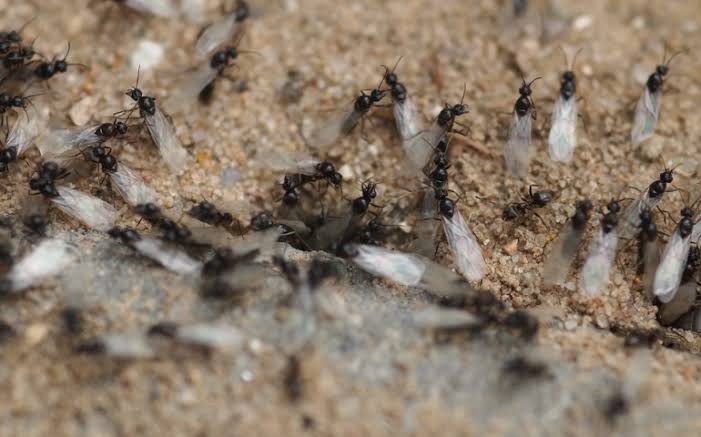
You walk into the kitchen on a warm summer evening and there are winged insects crawling on the windowsill, fluttering around the ceiling light, and scattered across the floor. They were not there this morning. They appeared in the span of a few hours, dozens or hundreds of them, and your first thought is that a nest somewhere in the house has just erupted. The good news is that flying ants appearing suddenly is a seasonal event, not an infestation emergency. It is called a nuptial flight, and it happens when conditions are right for ant colonies to send out their reproductive males and females to mate and start new colonies. The ants were always there. They just did not have wings until now.
Flying ants are not a separate species. They are the reproductive members of an existing ant colony, winged males and virgin queens that the colony produces once a year. The worker ants you see marching across the sidewalk are sterile females. They never grow wings. The flying ants are the colony’s investment in reproduction. They are produced in large numbers, held in the nest until environmental conditions trigger their release, and then sent out in a synchronized swarm that increases the odds that males and females from different colonies will find each other and mate. After mating, the males die within a day or two. The fertilized queens shed their wings, find a suitable nesting site, and start a new colony. The sudden appearance is the swarm leaving the nest all at once. The sudden disappearance is the males dying and the queens going underground.
Why Flying Ants Appear All at Once
The synchronized emergence of flying ants is triggered by weather. A warm, humid day following rain is the classic trigger. The soil is soft enough for the new queens to dig into after mating. The humidity prevents the ants from drying out during their brief flight. The temperature is high enough for their flight muscles to function. The combination of these three conditions, warm, humid, and post-rain, is why flying ant swarms tend to happen on the same day across an entire region. What appears to be a sudden infestation in your house is actually thousands of colonies in the area releasing their reproductives on the same afternoon.
The timing varies by species. Carpenter ants typically swarm in late spring, May and June. Pavement ants and field ants swarm in mid-summer, June through August. The swarm itself lasts a few hours. The winged ants emerge from the nest, climb to a high point, a blade of grass, a fence post, a windowsill, and take off. They are not strong fliers. They drift on air currents and gather near lights at night, which is why you find them clustered around porch lights and bathroom windows. The entire event from emergence to the last ant disappearing is typically 24 to 48 hours. If you are still seeing flying ants indoors after three days, the nest is inside the house.
Flying Ants vs. Termites: How to Tell the Difference
This is the identification that matters. Flying ants and flying termites look similar at a glance and both swarm in warm weather, but the response to finding them is completely different. Flying ants are a nuisance. Flying termites inside your house are a structural emergency. The differences are visible if you look closely at a single insect.
Ants have a pinched waist, the narrow segment between the thorax and the abdomen that gives them the classic hourglass body shape. Termites have a broad, straight body with no waist constriction. Ants have two pairs of wings of unequal length. The front pair is noticeably longer than the back pair. Termites have two pairs of wings of equal length that extend well past the end of the abdomen. Ants have elbowed antennae that bend at a sharp angle. Termites have straight, beaded antennae that do not bend. If you are looking at a winged insect in your house and you cannot tell whether it is an ant or a termite, catch one on a piece of clear tape and look at the waist. Pinched waist means ant. No pinch means termite. The difference is the difference between vacuuming up the insects and calling a pest control company immediately.
What to Check If Flying Ants Are Inside Your House
A few flying ants inside near a window or door that was open during the swarm is normal. They were attracted to the light and found their way in. Vacuum them up. The problem resolves itself within a day or two. Flying ants appearing repeatedly in the same room over multiple days, especially in a room without obvious access to the outside, suggests the colony is inside the house. Carpenter ants are the most common culprit for indoor nests. They tunnel into wet or damaged wood to create galleries for their colony. They do not eat the wood the way termites do. They excavate it, pushing sawdust-like frass out of the nest openings. The frass looks like fine wood shavings mixed with insect parts and is often the first sign of a carpenter ant nest.
Check for moisture problems. Carpenter ants nest in wood that has been softened by water damage. The colony almost always starts in a damp area: around a window frame that leaks, under a bathroom floor where the shower pan has been seeping, in a wall cavity below a roof leak, or in a deck ledger board attached to the house without proper flashing. The ants are a symptom of a moisture problem. Eliminate the moisture and the wood becomes less hospitable. The ants may leave on their own. If they do not, the nest needs to be located and treated.
Find the nest by following the ants. Worker ants, the wingless ones you see crawling, travel between the nest and their food sources along established trails. Follow the trail backward. It will lead to the nest opening, which may be a small hole in the wall, a gap in the baseboard, or an opening where a pipe enters the wall. The nest itself may be inside the wall cavity, in the insulation, or in a void under a cabinet. Treating the nest requires getting insecticide into the nest, either by injecting dust or foam into the opening, or by using bait that the workers carry back to the colony. If the nest is inaccessible or the infestation is extensive, call a licensed pest control professional. Carpenter ant nests that have been active for several years can compromise the structural integrity of the wood they are tunneling through.
How to Prevent Flying Ants From Returning
Seal entry points. Flying ants enter through gaps around windows, doors, vents, and utility penetrations. Caulk gaps around window frames and door casings. Install or repair weatherstripping. Screen attic vents and crawlspace openings with fine mesh. The ants that swarm outdoors will find their way indoors through any opening larger than an eighth of an inch.
Reduce moisture. Fix leaking pipes, dripping faucets, and any source of standing water near the foundation. Clean gutters and extend downspouts to direct water away from the house. Ventilate crawlspaces and basements. Replace water-damaged wood. The conditions that attract carpenter ants are the same conditions that cause rot. Fixing one fixes both.
Remove food sources. Ants forage for protein and sugar. Clean up food spills immediately. Store dry goods in sealed containers. Take out the trash regularly. Outdoor food sources like pet food, bird seed, and unrinsed recyclables attract ants near the house. Keep the perimeter of the foundation clear of mulch, leaf litter, and stacked firewood. A woodpile against the foundation is a carpenter ant nursery waiting to move indoors.
Frequently Asked Questions
Are flying ants dangerous or do they cause damage?
Flying ants themselves do not bite or sting any more than their wingless colony mates, and most common ant species in North America are not aggressive toward humans. The damage concern is with carpenter ants, whose nests can weaken structural wood over several years. A single swarm of flying ants is not a damage event. It is a sign that a colony exists somewhere nearby. If the swarm is outdoors, the colony is outdoors and is not a structural threat. If the swarm is indoors and repeats, the colony is indoors and needs to be addressed.
How do I get rid of flying ants quickly?
Vacuum them. A vacuum cleaner with a hose attachment removes flying ants from surfaces instantly. Empty the vacuum bag or canister outdoors immediately after use because the ants can crawl back out. A spray bottle with soapy water kills flying ants on contact by coating their breathing pores. Insecticide spray is unnecessary for a one-time indoor swarm. For persistent indoor swarms indicating a nest in the house, bait stations containing slow-acting insecticide that the workers carry back to the colony are more effective than sprays, which kill visible ants but leave the nest intact.
Why do flying ants appear at the same time every year?
The nuptial flight is triggered by a combination of temperature, humidity, and day length that recurs at roughly the same time each year. The colony produces reproductives on an annual cycle, and the environmental triggers for their release are seasonal. The ants in your yard this July are the descendants of the ants that swarmed last July. The timing may shift by a week or two depending on weather patterns, but the event is as regular as the first frost or the last snow. If you see flying ants on the same windowsill every June, the colony has been there for years and you are seeing its annual reproductive event.
The Bottom Line
Flying ants that appear suddenly inside your house are almost always a seasonal event, not an infestation crisis. They are the reproductive members of an existing colony, released in a synchronized swarm triggered by warm, humid weather after rain. The swarm lasts a day or two. The males die. The fertilized queens shed their wings and disappear into the soil. If the swarm happened indoors and does not repeat, the ants came from outside and found their way in through an open door or a gap in the weatherstripping. Vacuum them up. If flying ants appear indoors repeatedly in the same room over multiple days, especially if accompanied by wingless worker ants and sawdust-like frass, the colony is inside the house. Find the moisture problem that attracted them, locate the nest, and treat it or call a professional. The difference between a nuisance and a problem is not the ants themselves. It is where the nest is.