



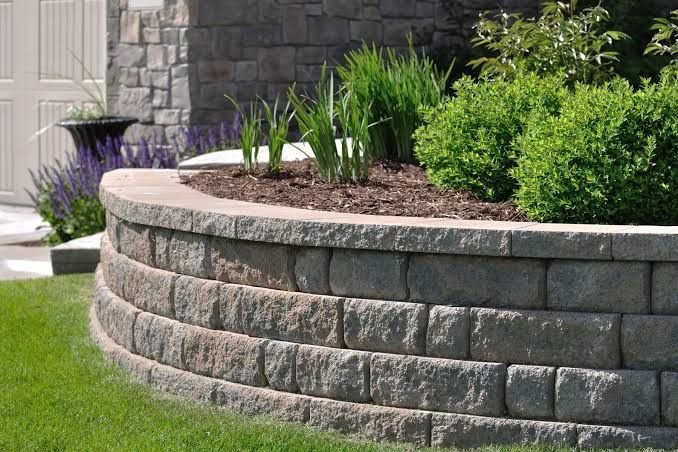
The cost to build a retaining wall depends on three things in descending order of impact: the material, the height, and whether you dig the footing yourself or pay someone else to do it, says Hawthorne property management. A three-foot segmental block wall 20 feet long costs $1,500 to $3,000 in materials and takes a weekend to build. The same wall built by a contractor costs $3,500 to $6,000. A four-foot natural stone wall of the same length costs $5,000 to $10,000 installed. The material is the dominant variable. The labor is a close second. The height is the multiplier that makes both of them more expensive.
Retaining wall costs are measured in square feet of wall face, the height of the wall multiplied by its length. A four-foot wall 30 feet long has 120 square feet of face area. At $25 per square foot installed for segmental block, that wall costs $3,000. At $50 per square foot for natural stone, it costs $6,000. The square-foot cost includes the materials, the gravel base, the drainage, the labor, and the equipment. It does not include permits, engineering, excavation beyond the basic trench, or repairs to anything that gets damaged during construction. Those are additional costs that this guide breaks down separately.
Cost by Material: Per Square Foot Installed
The material you choose sets the baseline cost. Everything else, labor, equipment, drainage, scales from there. A more expensive material usually requires more skilled labor, which multiplies the cost difference rather than simply adding to it.
| Material | Material Cost/sq ft | Installed Cost/sq ft | DIY Savings | Lifespan |
| Pressure-treated wood (post-and-board) | $8–$12 | $15–$25 | 35–45% | 15–25 yr |
| Railroad ties / cross ties | $6–$12 | $15–$25 | 40–50% | 25–40 yr |
| Segmental concrete block | $8–$15 | $20–$35 | 35–45% | 30+ yr |
| Cinder block (CMU) with rebar and concrete fill | $10–$18 | $25–$45 | 25–35% | 50+ yr |
| Dry-stacked sandstone | $12–$25 | $30–$55 | 30–40% | 100+ yr |
| Dry-stacked fieldstone | $10–$20 | $30–$50 | 30–40% | 100+ yr |
| Poured concrete (formed and reinforced) | $15–$25 | $30–$60 | 20–30% | 50+ yr |
The installed cost includes excavation, gravel base, drainage pipe and gravel backfill, materials, labor, and cleanup. The DIY savings percentage represents the labor portion of the total cost. Materials cost roughly the same whether you buy them or a contractor buys them. The contractor’s trade discount is typically 10 to 15 percent, not 50 percent. The savings from DIY are almost entirely the labor you do not pay for.
Cost by Wall Height: The Multiplier Effect
A taller wall costs more than a shorter wall, and not just because it uses more materials. The relationship is not linear. A four-foot wall costs more than twice what a two-foot wall costs per square foot because the engineering requirements change. A wall over three to four feet requires a deeper footing, more gravel, larger deadman anchors or geogrid reinforcement, and in many jurisdictions a permit and engineered drawings. The jump from three feet to four feet is the most expensive 12 inches in retaining wall construction.
| Wall Height | Segmental Block (20 ft run) | Natural Stone (20 ft run) | Additional Costs |
| 2 ft | $800–$1,600 | $1,200–$2,500 | Usually no permit required |
| 3 ft | $1,200–$2,500 | $1,800–$4,000 | Permit may be required |
| 4 ft | $2,000–$4,500 | $3,000–$6,500 | Permit likely, deeper footing, more drainage |
| 6 ft | $5,000–$10,000 | $8,000–$15,000 | Engineer stamp, geogrid, larger equipment |
Additional Costs Beyond the Wall Itself
Drainage adds $200 to $800 to a typical residential wall for the gravel backfill, perforated pipe, landscape fabric, and the labor to install them. Drainage is not optional. A wall without drainage will fail. Some contractors include basic drainage in their installed price per square foot. Some price it separately. Ask which it is before signing the contract. A quote that seems $500 cheaper than the next one may be missing the drainage line item entirely.
Permits cost $50 to $500 depending on the municipality. Walls over three to four feet typically require a permit. The permit requires a site plan showing the wall location, height, and setback from property lines. Some jurisdictions require stamped engineering drawings for walls over four feet or walls retaining a surcharge like a driveway. An engineered design costs $500 to $2,000 depending on the wall height and the engineer’s hourly rate. The engineer’s stamp is not a suggestion. A building department will not issue a permit for a retaining wall over a certain height without one.
Excavation beyond the basic trench adds cost if the site conditions are difficult. Rocky soil that requires a jackhammer attachment adds $500 to $1,500. A steep slope that requires a mini excavator instead of hand digging adds $300 to $800 for the equipment rental. Soil disposal adds $200 to $600 if the excavated material cannot be spread on site and must be hauled away. Access limitations add cost. A backyard with no side gate wider than 36 inches means materials are carried by hand or a mini loader is rented. Hand-carrying three tons of block and gravel costs hours of labor that show up on the invoice.
Repairing or replacing what gets damaged during construction is an often-overlooked cost. A retaining wall excavation near a lawn will damage the grass in a strip several feet wide along the wall line. Re-sodding or reseeding costs $100 to $400. Irrigation lines running through the excavation zone will be cut and need repair, $100 to $300. The costs are small individually but they add up. A contractor’s quote should specify what is included and what is additional. If it does not, ask before the shovel goes in the ground.
DIY vs. Professional Installation: The Labor Equation
The labor to build a retaining wall is 40 to 60 percent of the installed cost. That is the amount you save by doing it yourself. The trade-off is time, physical effort, and the learning curve. A segmental block wall that a contractor builds in two days takes a first-time DIY builder four to six days. A natural stone wall that a mason builds in three days takes a DIY builder seven to ten. The time difference is the mason’s experience selecting stones and fitting them quickly versus the homeowner holding up each stone, trying it in three different positions, and putting it back in the pile to try a different one.
The DIY decision depends on the material. Segmental block is the most DIY-friendly. The blocks are uniform, the interlocking lip sets the batter automatically, and the process is the same for every block. Natural stone is the least DIY-friendly. Each stone is unique, the fitting requires judgment, and the learning curve is steep. Wood and railroad tie walls fall in the middle. The fastening is straightforward but the materials are heavy. A cordless drill and a circular saw can build a wood wall. A chainsaw and a sledgehammer can build a tie wall. Natural stone requires a strong back, a good eye, and patience.
Frequently Asked Questions
What is the cheapest retaining wall to build?
Pressure-treated wood is the cheapest material at $8 to $12 per square foot for materials and $15 to $25 installed. Railroad ties are comparable at $6 to $12 for materials. The trade-off for the lower upfront cost is a shorter lifespan. A wood wall lasts 15 to 25 years. A segmental block wall lasts 30 or more. A natural stone wall lasts 100 or more. Over a 30-year period, the wood wall may need to be rebuilt once, doubling its effective cost. The cheapest wall at the time of construction is not necessarily the cheapest wall over the life of the property.
How much does a retaining wall cost per linear foot?
A four-foot segmental block wall costs $80 to $140 per linear foot installed. A four-foot natural stone wall costs $120 to $220 per linear foot. Per-linear-foot pricing is useful for quick estimates but less precise than per-square-foot pricing because it assumes a specific wall height. When comparing quotes, convert everything to cost per square foot of wall face. That is the unit that is consistent across different wall heights and allows an apples-to-apples comparison.
How do I get accurate retaining wall quotes?
Get three quotes from licensed and insured contractors. Provide each with the same written scope of work including wall height, length, material type, and any site conditions that affect access. Ask for itemized pricing that separates materials, labor, drainage, and equipment. Ask what is not included. Permits, engineering, soil disposal, and landscape repair are common exclusions. The quote that is significantly lower than the others is either missing something or the contractor has not built many retaining walls and is pricing the job to get the experience. Neither is a good reason to choose the low bid.
The Bottom Line
Retaining wall costs are driven by the material and the height. Wood is the cheapest and shortest-lived. Concrete block is the middle ground. Natural stone is the most expensive and the longest-lived. The jump from three feet to four feet in wall height is the most expensive single foot in the project because it triggers permit requirements, deeper footings, and more extensive drainage. The labor to install the wall is 40 to 60 percent of the total cost and is the portion you save by doing it yourself. The drainage, the permits, and the engineering are costs that cannot be avoided. A retaining wall is a structure that holds back earth. The forces involved are larger than they look, and the cost of building it correctly the first time is always less than the cost of rebuilding it after it fails.