



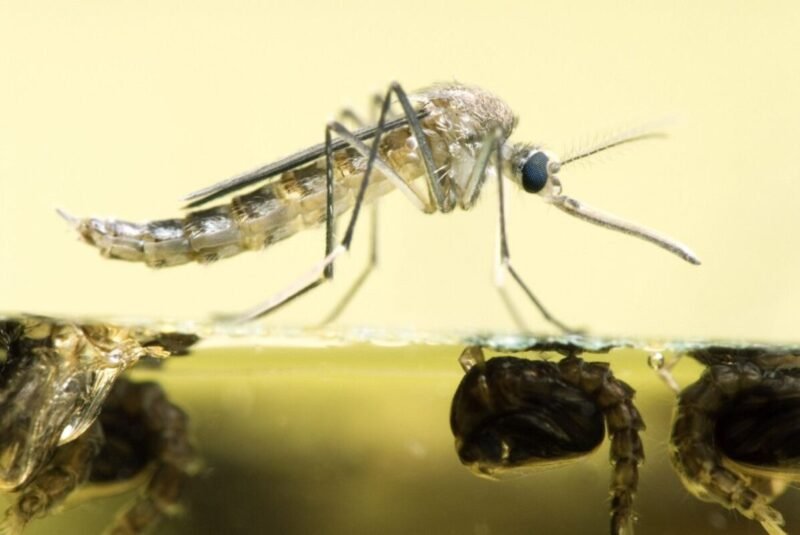
According to Sunnyvale property management, the most effective mosquito larvae predator in the world is a fish the size of your little finger. Mosquitofish, Gambusia affinis, eat their body weight in larvae every day, reproduce rapidly, and are distributed free by county vector control districts across the United States. They are not the only fish that eats mosquito larvae. They are the most efficient per inch of body length. Goldfish, koi, guppies, minnows, and bluegill all eat mosquito larvae. The question is not whether a fish will eat larvae. Most fish will. The question is which fish is appropriate for the water body you have, will survive the temperature range of that water body, and will not cause ecological problems if it escapes into natural waterways.
The wrong fish in the wrong water is a dead fish or an invasive species. A goldfish released into a natural pond becomes a 12-inch bottom-feeder that outcompetes native fish. A mosquitofish in a birdbath dies within hours from heat and oxygen depletion. A koi in a seasonal drainage ditch dies when the ditch dries up in July. Matching the fish to the water is the step that separates effective mosquito control from a well-intentioned failure.
Fish Species: What Works, Where, and Why
Mosquitofish, Gambusia affinis and Gambusia holbrooki, are the standard for mosquito control. A single female eats 100 to 500 larvae per day. They are live-bearing, meaning they give birth to free-swimming young rather than laying eggs. A small population introduced to a pond in the spring will multiply to hundreds by late summer. They tolerate water temperatures from just above freezing to over 100 degrees Fahrenheit and survive in water with very low dissolved oxygen by gulping air at the surface. They are available free from vector control districts in most states. Call your county’s mosquito abatement office and ask. The fish are free. The service is taxpayer-funded.
Mosquitofish are invasive outside their native range in the southeastern United States. They have been introduced worldwide and have displaced native fish species in many regions. They should only be used in enclosed water features that do not connect to natural waterways. A pond with an overflow that reaches a stream will eventually send mosquitofish downstream. If your pond connects to natural water, use native fish instead.
Goldfish and koi eat mosquito larvae and are suitable for ornamental ponds. A single goldfish will keep a small pond free of larvae. Goldfish tolerate cold water and will survive winter in a pond that does not freeze solid. Koi are larger, more expensive, and produce more waste. They eat larvae but are not as efficient per fish as goldfish or mosquitofish because they spend more time foraging on the bottom. Both goldfish and koi are invasive if released into natural waterways. Never release pet fish into a stream, pond, or lake.
Fathead minnows, Pimephales promelas, are native to much of North America and eat mosquito larvae along with algae and detritus. They are less efficient per fish than mosquitofish but are native and non-invasive in their natural range. They are available from bait shops and pond supply companies. Fathead minnows are a better choice than mosquitofish for ponds that connect to natural waterways. Bluegill and other sunfish eat mosquito larvae when they are young. Adult bluegill prefer larger prey but will eat larvae if nothing else is available. Bluegill are native to eastern and central North America and are appropriate for larger ponds.
Guppies, Poecilia reticulata, eat mosquito larvae and are used for mosquito control in tropical and subtropical regions. They cannot survive water temperatures below 55 degrees. In the southern United States, guppies can survive year-round in outdoor ponds. North of roughly the 35th parallel, they die in the winter and must be restocked each spring. Guppies reproduce rapidly and a small population introduced in the spring will produce hundreds of offspring by summer.
| Fish | Larvae/Day | Cold Tolerance | Best For | Native/Invasive |
| Mosquitofish | 100–500 | Excellent | Ponds, troughs, ditches | Invasive outside SE US |
| Goldfish | 50–200 | Excellent | Ornamental ponds | Invasive everywhere |
| Fathead minnow | 30–100 | Excellent | Natural ponds | Native (much of NA) |
| Guppy | 50–150 | Poor (dies <55°F) | Warm climates | Invasive in warm regions |
| Bluegill | 20–50 (juveniles) | Excellent | Large ponds | Native (east/central NA) |
| Koi | 20–50 | Excellent | Large ornamental ponds | Invasive everywhere |
Stocking Rates and Water Requirements
The stocking rate depends on the size of the water body and the severity of the mosquito problem. For a small ornamental pond up to 200 gallons, five to ten mosquitofish or two to three small goldfish are sufficient. For a larger pond, stock roughly one mosquitofish per five to ten square feet of water surface. The fish will reproduce and self-regulate their population based on the available food supply. Overstocking leads to starvation and poor water quality. Understocking leaves enough larvae uneaten to produce adult mosquitoes.
The water must be able to support the fish year-round. A pond that freezes solid in winter needs to be deep enough that the fish can survive below the ice. Goldfish and koi need at least 18 to 24 inches of unfrozen water below the ice to survive winter. A birdbath, a rain barrel, and any container smaller than roughly 30 gallons cannot support fish through the temperature extremes of summer and winter. These containers should be treated with mosquito dunks containing Bti, dumped and refilled weekly, or covered with a tight-fitting screen. Fish are for permanent water bodies. Dunks and dumping are for containers.
Common Mistakes With Fish-Based Mosquito Control
Mistake one: putting fish in water that kills them. A birdbath in full sun reaches 90 degrees by noon and loses most of its dissolved oxygen. A mosquitofish will die in a birdbath within hours. Match the fish to the water body. If the water is too small or too hot for fish, use mosquito dunks.
Mistake two: introducing non-native fish into natural waterways. A pond that overflows during heavy rain can carry mosquitofish, goldfish, or guppies into streams and wetlands. The fish establish breeding populations and compete with native species. Use native fish if the water body connects to natural waterways. Use non-native fish only in enclosed, contained water features.
Mistake three: feeding the fish. Fish that are fed will eat the fish food and ignore the mosquito larvae. The fish must be hungry to hunt larvae. In a pond with an established insect population, the fish do not need supplemental feeding. They will find enough to eat, and mosquito larvae will be on the menu. If you must feed the fish for aesthetic reasons, feed them sparingly and accept that their mosquito control efficiency will decrease.
Frequently Asked Questions
Where can I get mosquitofish for free?
County vector control districts, mosquito abatement offices, and some public health departments provide mosquitofish free to residents. Call the non-emergency number for your county’s environmental health or vector control department and ask. The service is available in most states. The fish are typically available from spring through early fall. Some districts deliver. Some require pickup. The fish are free regardless.
What happens to mosquito-eating fish in the winter?
In ponds that do not freeze solid, goldfish, koi, fathead minnows, and mosquitofish survive the winter by going dormant near the bottom where the water is slightly warmer. They stop eating and become inactive. In the spring, they resume feeding and will begin eating mosquito larvae as soon as the larvae appear. Guppies and other tropical fish die when the water temperature drops below 55 degrees and must be restocked each spring in climates with cold winters.
Will birds eat the fish I put in my pond?
Herons, egrets, and kingfishers will eat small fish from ornamental ponds. A pond that is shallow and has no hiding places will lose fish to birds. Provide cover: submerged plants, rock overhangs, or a deep section where fish can retreat. Mosquitofish are particularly vulnerable because they spend most of their time near the surface where birds can see them. A pond with a mix of open water and cover supports both the fish and the birds without the birds eating all the fish.
The Bottom Line
Mosquitofish are the most efficient mosquito larvae predator per inch of fish and are available free from vector control districts. Goldfish and koi work in ornamental ponds. Fathead minnows are the native alternative for ponds that connect to natural waterways. Guppies work in warm climates. The fish must be matched to the water body: size, temperature range, and connection to natural waterways. A fish in the wrong water is dead or invasive. A fish in the right water eats mosquito larvae every day, reproduces, and controls the mosquito population without chemicals, without electricity, and without any effort beyond the initial stocking. The fish do the work. You just put them in the right place.