



Commercial HVAC systems influence far more than the temperature on a thermostat. They affect occupant comfort, operating costs, equipment reliability, moisture control, and the ability to keep daily business activities moving without interruption.
A practical maintenance plan begins with understanding the building and the equipment serving it. Property owners and facility teams can use https://www.tsshvac.com/commercial-services/ as a starting point when evaluating the scope of professional support their building may need.
Why Commercial HVAC Maintenance Matters
Waiting for equipment to fail can lead to emergency scheduling, tenant complaints, lost productivity, and higher repair costs. Preventive maintenance gives teams an opportunity to find worn components, blocked drains, airflow problems, and failing controls before they trigger a major outage. It also supports safer operation by confirming that electrical connections, safety switches, and combustion-related components receive regular attention.
Weather swings, wildfire smoke, changing occupancy, and higher utility costs can place additional pressure on commercial systems. Maintenance is not simply a repair strategy. It is a way to keep heating, cooling, and ventilation aligned with the building’s actual demands.
How Building Use Changes HVAC Needs
No single maintenance schedule fits every property. Offices may need airflow and scheduling adjustments as hybrid occupancy changes. Retail spaces deal with frequent door openings, while warehouses can have large temperature differences between loading areas and interior zones. Restaurants must manage heat, grease, and exhaust, and industrial facilities may contend with dust, fumes, or process heat.
For example, a lightly occupied office may need attention on thermostat schedules and ventilation settings. A busy retail store or food-service space may require more frequent filter checks, outdoor-air inspections, and checks for pressure problems near entrances and exhaust systems.
What A Strong Maintenance Plan Includes
Routine Inspection Tasks
- Inspect filters for condition, fit, and replacement needs.
- Check belts, bearings, motors, electrical connections, and safety controls.
- Clean coils and confirm adequate airflow through supply and return paths.
- Inspect condensate pans and drains for standing water or blockages.
- Test thermostats, sensors, dampers, and control sequences.
- Investigate unusual odors, vibrations, sounds, or temperature changes.
Seasonal And Condition-Based Service
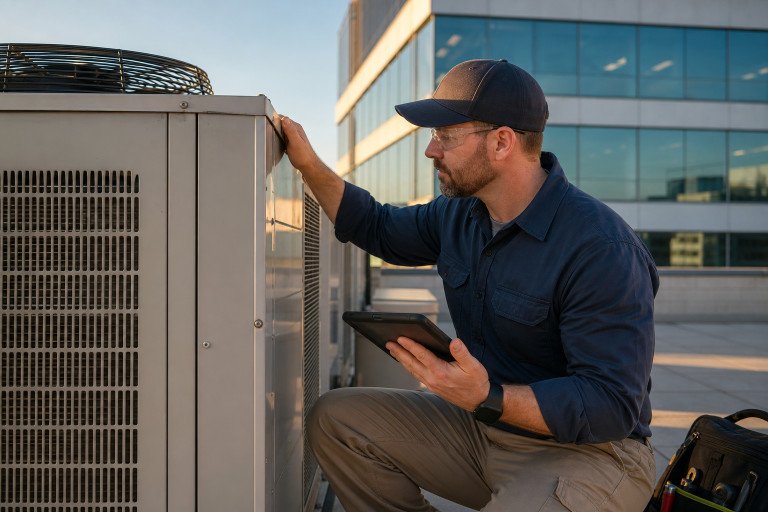
Cooling equipment should be reviewed before high-demand warm weather, while heating equipment needs inspection before cold conditions arrive. Roof-mounted units also need checks for debris, corrosion, and weather damage. Do not wait for the next planned visit when energy use rises sharply, a zone has repeated comfort complaints, or a sensor flags abnormal operation.
HVAC Care And Indoor Air Quality
Indoor air quality is shaped by source control, ventilation, filtration, moisture management, and airflow. Facility teams can benefit from identifying building conditions and managing indoor air quality as connected tasks rather than treating each complaint as an isolated event.
Review filter condition, outdoor-air intakes, exhaust operation, humidity, water leaks, blocked grilles, pressure differences, and persistent odors. A higher-efficiency filter is not automatically the best solution. The selected filter must be compatible with the equipment’s available airflow and pressure limits.
Controlling Energy Use Without Sacrificing Comfort
Before considering a major replacement, address basic performance issues. Repair duct leaks, protect damaged insulation, keep coils clean, calibrate sensors, and use occupancy schedules that match how the building is actually used. Review economizer operation and outdoor-air controls as well.
Energy savings should never come at the expense of necessary ventilation or comfort. Effective control strategies consider energy, indoor air quality, and thermal comfort together. Tracking energy use alongside weather and occupancy patterns can reveal waste that is not obvious during a single service visit.
Warning Signs That Need Attention
- Uneven room temperatures or weak supply airflow.
- Frequent cycling, unusually long run times, or new noises.
- Water near air handlers, rust, visible moisture damage, or mold.
- Musty, burning, or chemical odors.
- Unexpected energy spikes or repeated complaints from one area.
Small symptoms often point to issues that are less expensive to correct early, such as a clogged drain, failing sensor, loose belt, dirty coil, or blocked return opening.
Building A Commercial HVAC Emergency Plan
List critical equipment, the areas each unit serves, and spaces that need priority protection, such as server rooms, clinics, kitchens, or inventory areas. Keep model numbers, control information, warranties, service records, and after-hours contacts in one accessible location.
During a heating failure on a busy workday, a written plan can help staff quickly identify affected zones, move occupants if needed, protect sensitive equipment, communicate with tenants, and arrange temporary measures. After the event, document the cause and update the plan.
Why Service Records And System Data Matter
Track service dates, completed tasks, parts replaced, filter sizes, temperature and humidity complaints, equipment age, warranties, energy changes, and recommendations that still need action. Sensors and building automation systems can add useful detail, but the value comes from reviewing the information and acting on clear trends.
Common Questions About Commercial HVAC Maintenance
How Often Should A Commercial HVAC System Be Serviced?
Many properties benefit from seasonal inspections, while high-use, high-occupancy, food-service, medical, and industrial spaces may need more frequent checks.
Can Maintenance Lower Energy Costs?
Clean components, accurate controls, proper airflow, and timely repairs can reduce wasted operation, although savings depend on the building and system condition.
When Should Equipment Be Replaced?
Consider age, repair history, recurring comfort issues, efficiency, parts availability, refrigerant concerns, and the ongoing cost of keeping the unit in service.
Final Thoughts
A reliable commercial HVAC plan combines scheduled maintenance, indoor air quality reviews, energy oversight, useful records, and emergency preparation. The goal is not to adopt every new technology. It is to maintain a safe, comfortable, efficient building that is ready for everyday demands.