




Finding where ants are coming from is the step between noticing the ants and getting rid of them. It is the step most people skip. They see ants on the kitchen counter, spray them, wipe up the bodies, and go back to making coffee. The ants return in an hour. The spray killed the workers. It did nothing to the colony, and it did nothing to close the entry point the workers used to get in. Finding the source means following the ants back to where they entered the house, and in some cases, all the way back to the nest itself. The process takes 20 minutes. The result is knowing exactly where to seal, where to bait, and whether the problem is an outdoor colony sending in foragers or an indoor colony living in the wall, shares Invest West Property Management company.
The fundamental rule of ant tracking is: do not kill the ants you are tracking. A dead ant does not lead anywhere. A living ant walking along its pheromone trail is a map back to its nest. The trail of ants crossing your kitchen floor is not an invasion. It is a line on a map. Follow it in both directions. One direction leads to the food or water source the ants are foraging. The other direction leads to the entry point and eventually to the nest. The entry point is the hole in the wall, the gap under the door, the crack in the foundation. The nest is where the queen lives. Find the entry point and you can seal it. Find the nest and you can eliminate the colony.
Step 1: Follow the Trail Without Disturbing It
Find a place where ants are moving in a steady line. A trail of ten or more ants moving in both directions is ideal. A single ant wandering randomly has lost the trail and will not lead anywhere useful. Watch the trail for a minute to confirm the direction of travel. Ants moving away from the food source are heading back toward the nest. Ants moving toward the food source are heading away from the nest. You want to follow the ants heading away from the food, toward the nest. They are carrying food back to the colony. They know where they are going.
Follow the trail slowly. Do not cast a shadow over the ants. A sudden shadow triggers an alarm response and the ants scatter. Move furniture out of the way before you start tracking so you do not have to move it while following the trail. The trail will lead to a baseboard, a door frame, a window sill, a pipe penetration, or a crack in the wall. The ants will disappear into a gap that is often barely visible. A crack between the baseboard and the floor that you would never notice if ants were not walking into it. An opening around a pipe under the sink that is hidden behind cleaning supplies. A gap in the caulk around the window frame that looks sealed until you see an ant squeeze through it.
Mark the entry point. A piece of blue painter’s tape next to the gap, not over it, marks the spot without blocking the ants you may want to bait later. If the trail splits, follow the larger branch. If the trail leads to a crack in an exterior wall and the ants are heading outside, step outside and look at the same spot on the exterior. The exterior entry point is often a crack in the foundation, a gap where the siding meets the foundation, or an opening around an outdoor faucet or utility penetration.
Step 2: Use Bait to Map the Trail When Ants Are Not Active
Ants are not always marching in a visible line. If you find a few ants scattered across the counter but no trail, place a small drop of honey or a dab of jelly on a piece of wax paper near where you saw the ants. Leave it for 30 minutes. If ants are foraging nearby, they will find the bait and a trail will form. The trail that develops from the bait will lead back to the entry point the same way a natural trail does. The bait is a tool for making the trail visible, not a treatment. Once the trail is established, follow it back to the entry point as described in step one.
For nighttime tracking, when ants are less active, place bait before you go to bed and check it first thing in the morning. Ants often forage at night when the house is quiet and the lights are off. A trail that was not there at 10 p.m. may be fully developed by 6 a.m. The morning trail is the best trail to follow because the ants have been working it for hours and the pheromone scent is strong.
Step 3: Check the Most Common Entry Points Systematically
If you cannot find an active trail, check the most common entry points in order of likelihood. Start in the room where you see ants most often. Check the baseboard gaps first. Run a flashlight parallel to the baseboard where it meets the floor. The light will cast a shadow into any gap, making it visible. Ants entering through a baseboard gap are coming from the wall cavity, which means the nest is inside the wall, in the crawlspace below, or in the attic above.
Check under sinks. The gaps around the water supply lines and the drain pipe are the most common ant entry points in kitchens and bathrooms. The holes were drilled larger than the pipes, and the gaps were never sealed. An ant entering through a pipe gap under the sink may be coming from the crawlspace, the basement, or an exterior wall. Pull everything out of the cabinet. Shine a flashlight along the back wall. Look for ants, frass, sawdust-like debris that carpenter ants push out of their nest openings, or moisture stains that indicate a leak attracting ants.
Check around windows and doors. The gap between the window frame and the wall is a common entry point, especially on the ground floor. Run your hand along the edges of the window trim. Feel for drafts. A draft you can feel is a gap an ant can walk through. Check the weatherstripping on exterior doors. Look at the door sweep at the bottom. A gap under the door large enough to slide a piece of paper through is large enough for ants.
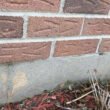
Check the exterior foundation. Walk around the outside of the house and look at the foundation where it meets the ground. Look for ant trails going up the foundation wall. Look for cracks in the concrete or gaps in the mortar. Look for mulch, leaf litter, or firewood stacked against the foundation. These materials create a bridge from the soil to the siding that ants use to bypass the foundation. Pull mulch back from the foundation by at least six inches. Move firewood at least 20 feet from the house. A woodpile against the foundation is an ant colony with a direct access door to your house.
Step 4: Look for Signs of an Indoor Nest
An indoor ant nest leaves evidence. Carpenter ants push frass out of their nest openings. The frass looks like fine sawdust mixed with insect body parts and accumulates in a small pile directly below the nest opening, often on a windowsill, in a corner of a cabinet, or on the floor against a baseboard. Finding frass means the nest is directly above or behind the pile. The nest opening is a small hole, often the size of a pencil lead, in the wood above the frass pile.
Listen for the nest. A large carpenter ant colony produces a faint rustling sound that you can hear if the house is quiet. The sound is the ants moving through their galleries in the wood. Press your ear against the wall where you suspect the nest. Tap the wall lightly. If ants are nesting inside, the tapping may trigger a brief increase in the rustling sound as the ants respond to the vibration. This technique works best at night when the house is silent and the ants are active.
Look for moisture damage. Indoor ant nests are almost always associated with wet wood or consistently damp areas. Check around windows that leak during rain. Check under bathrooms where the shower pan or tub may have been seeping. Check in the basement or crawlspace where a plumbing leak has been dampening the subfloor. The moisture map of your house is also the ant nest probability map. Wherever water has been getting into wood, ants may have followed.
Frequently Asked Questions
What if I see ants but there is no visible trail to follow?
Place bait, a small drop of honey or jelly on wax paper, near where you saw the ants and wait 30 minutes. The bait will attract foragers and a trail will develop. If no ants appear at the bait after an hour, the ants you saw were scouts that have since moved on. Try again at a different time of day. Ants are often most active in the early morning and late evening. If you consistently see ants in the same area but never find a trail, the nest is likely in the wall or floor directly adjacent to where the ants appear.
How do I find an ant nest in the yard?
Follow the trail from the house outward. Ants entering the house from outside are following a trail from the nest to the house. Walk the exterior perimeter and look for ants on the foundation. Follow any trail you find away from the house. Outdoor nests are often under rocks, in rotting stumps, in mulch beds, along sidewalks, or at the base of trees. Look for small mounds of soil with an opening in the center. Pouring a small amount of water mixed with a drop of dish soap onto a suspected nest opening will cause ants to boil out of the ground within seconds if a nest is present.
What if ants are appearing in multiple rooms?
Multiple entry points are uncommon. More likely, there is a single nest in a wall cavity or crawlspace and the ants are emerging through multiple openings into different rooms. Follow the trail in each room. If all trails lead back to the same general area, a shared wall, a plumbing chase, or a central hallway, the nest is in that shared structure. Treating the nest at its source solves the problem in all rooms simultaneously. Treating each room individually leaves the nest intact and the ants will find new openings into the treated rooms within days.
The Bottom Line
Finding where ants are coming from is a process of following the trail backward from the food source to the entry point, and from the entry point to the nest. Do not kill the ants you are tracking. Follow them. Mark the entry point. Check the common entry points in order: baseboards, under sinks, around windows and doors, along the exterior foundation. Look for frass, the sound of rustling in the walls, and moisture damage that attracts nesting ants. The 20 minutes you spend tracking ants is the difference between spraying the same spot every week for a year and solving the problem once by sealing an entry point or eliminating a nest. The ants know where they came from. Your job is to pay attention while they show you.