



A water heater failure isn’t a minor inconvenience — it’s a four-figure emergency. Between flood damage to your flooring, drywall, and personal belongings, a sudden tank rupture can easily cost you $4,000 to $7,000 in repairs, not counting the replacement unit itself, warns Niagara Falls property management.
The good news is that your water heater rarely fails without warning. There are clear, observable signs — from rusty water and popping noises to a failing pressure relief valve — that tell you exactly how much time you have left. Recognizing these signals early is the difference between a planned $1,200 replacement and a panicked 2 AM call to a plumber.
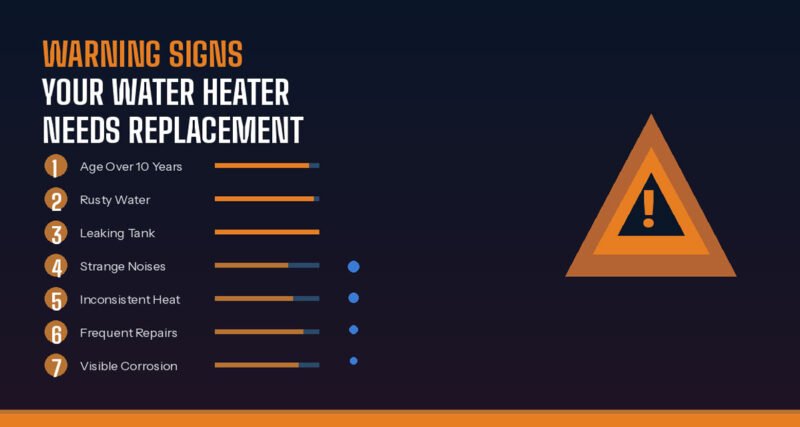
This article walks through the 7 definitive signs your water heater needs replacement, covering both traditional tank units and tankless systems. You’ll learn how sediment buildup accelerates internal corrosion, when an anode rod replacement is still worth doing, and how a unit’s energy factor (EF) rating affects your decision to repair or replace. By the end, you’ll have a practical checklist to self-diagnose your system and decide whether to call a pro or start shopping.
1. Age: Is Your Water Heater Past Its Prime?
Age is the single strongest predictor of water heater failure — more reliable than noise, rust, or even minor leaks. Most homeowners wait until a catastrophic leak floods their basement before checking the date. By then, the decision has already been made for you.
Standard tank water heaters last between 10 and 15 years under normal conditions. Tankless units can push past 20 years with proper maintenance. But those are maximums, not guarantees. Sediment buildup in water heater tanks accelerates corrosion from the inside out, silently reducing lifespan regardless of the manufacturer’s sticker.
Tank Water Heaters (10-15 years) — How to Find the Manufacture Date
Every tank water heater has a serial number sticker on the side, usually near the top or on the energy guide label. The manufacture date is baked into that code. Rheem and Ruud use a format like “M1234” , where “M” is the month (A=January, B=February, skipping “I”) and the first digit after the letter is the year. Bradford White stamps a date code directly. A.O. Smith units use a four-digit serial prefix: the first two numbers are the year, the last two are the week.
If the sticker is faded or missing, check the pressure relief valve date stamp or the anode rod access panel. What many homeowners don’t realize: the warranty clock starts ticking the day the unit leaves the factory, not the day it was installed. A water heater sitting in a warehouse for two years before installation has already lost that time.
Once a tank heater passes the 10-year mark, the internal glass lining has typically degraded enough that the steel tank is exposed to water. That’s when pinhole leaks develop , often without visible exterior rust until the leak is significant.
Tankless Water Heaters (20+ years) , Why They Last Longer but Still Need Attention
Tankless heaters avoid the standing-water corrosion problem entirely, which is why their lifespan can reach 20 years or more. But they have a different vulnerability: mineral scaling inside the heat exchanger. Hard water deposits build up over time, reducing flow rate and forcing the burner to work harder. The energy factor (EF) rating drops as scaling increases , you’ll see it in higher gas bills long before you notice lukewarm showers.
For tankless owners, the critical maintenance milestone is anode rod replacement every 3-5 years. Yes, tankless units have anode rods too , they protect the heat exchanger from electrolytic corrosion. Skip this, and you’ll lose 5-10 years of potential service life. By contrast, a tank-style heater that has never had its anode rod inspected is essentially a ticking clock after year eight.
The bottom line on age: if your tank heater is past 12 years or your tankless unit is past 18 and has never been descaled, you’re operating on borrowed time. The question isn’t if it will fail , it’s whether you’ll replace it on your schedule or the floor’s.
2. Water Around the Base: A Leak You Can’t Ignore
A puddle forming around your water heater is the single most urgent sign your water heater needs replacement , but not every wet floor means the tank is dead. The distinction between a minor fitting leak and a tank failure is straightforward, and getting it wrong can cost you either an unnecessary replacement or a catastrophic flood.
How to check if the leak is from the tank itself vs. a pipe fitting
Dry the area completely with a towel. Wait 30 minutes. Look again. Water pooling directly under the tank body, especially near the bottom seam, means the inner steel liner has corroded through. That is not repairable. The tank is compromised, and the unit must be replaced immediately.
Water dripping from the water heater pressure relief valve (the brass fitting on the side or top with a small lever) or from the threaded connections where pipes enter the top of the unit is a different story. Those are external fittings. A loose connection, a worn gasket, or a faulty valve can often be tightened or replaced for under $50. The tank itself is fine.
One thing most homeowners miss: condensation. In humid basements, cold water pipes can sweat enough to pool around the base and mimic a leak. Wipe everything dry, run hot water for 10 minutes, and recheck. If the floor stays dry, you’re dealing with condensation, not corrosion.
Here is the practical rule of thumb for deciding what to do:
| Leak Location | Likely Cause | Action Required | Typical Cost |
|---|---|---|---|
| Bottom seam or side of tank | Rust-through from sediment buildup in water heater | Replace unit immediately | $800–$1,500 |
| Pressure relief valve | Faulty valve or excess pressure | Replace valve or check expansion tank | $15–$50 |
| Top pipe connections | Loose nut or worn gasket | Tighten or replace gasket | $5–$30 |
| Under the unit (no visible source) | Condensation or slow tank seep | Dry and monitor 24 hours; call pro if wet returns | $0 or service call fee |
If the leak is from the tank itself, do not attempt a patch. Water heater manufacturers explicitly warn against sealants or epoxy repairs on the tank liner , they fail under pressure, often catastrophically. According to the National Fire Protection Association (2025), water heater failures cause an estimated 4,200 residential fires annually in the U.S., many originating from unaddressed tank leaks that short electrical components or damage gas burner assemblies.
A tank leak is a hard deadline. You have hours, not weeks, before the situation escalates from a wet floor to structural water damage or a safety hazard. Turn off the power (breaker for electric units; gas valve to pilot for gas units) and shut off the cold water supply valve feeding the heater. Then call a licensed plumber for replacement.
3. Rusty or Discolored Water: A Sign of Internal Corrosion
Rusty or discolored hot water is one of the clearest signs your water heater needs replacement, but not every brown tap means the tank is doomed. The key is knowing which type of rust you’re dealing with , and whether it disappears after a few seconds.
If the rusty water clears up after running the tap for 30–60 seconds, the source is likely your iron pipes, not the heater itself. That’s a plumbing issue, not a replacement trigger. But if the discoloration persists , or only shows up on the hot water side , the corrosion is inside the tank. That’s the real problem.
What Causes Rusty Hot Water
Inside every tank-style water heater sits a sacrificial anode rod, typically made of magnesium or aluminum. Its job is to corrode instead of the steel tank. According to the U.S. Department of Energy (2024), these rods last roughly 3–5 years depending on water chemistry. Once the rod is consumed, the tank itself becomes the next target for corrosion.
Sediment buildup in water heater tanks accelerates this process. Minerals settle at the bottom, creating a barrier that traps heat and causes the tank floor to overheat. That heat stress, combined with exposed steel, produces rust that mixes directly into your hot water supply.
What to Do: Flush the Tank First, Then Test If the Issue Returns
Before you call for a replacement, run a diagnostic flush. Here’s the step-by-step:
- Turn off the power or gas to the unit. For electric heaters, flip the breaker. For gas, set the thermostat to “pilot.”
- Attach a garden hose to the drain valve at the bottom of the tank. Run the other end to a floor drain or outside.
- Open the pressure relief valve (usually a lever on the side or top) to let air into the tank. This prevents a vacuum lock.
- Drain the tank completely. If the water comes out brown or full of grit, sediment buildup is severe.
- Refill and flush again with cold water for 5–10 minutes. Close the drain valve, refill the tank, and restore power.
Wait 24 hours. If the hot water runs clear, your anode rod replacement may still be possible , call a plumber to inspect it. If the rust returns, the tank lining is compromised. At that point, replacement is the only safe option.
| Symptom | Likely Cause | Action |
|---|---|---|
| Rust clears after 30 seconds | Iron pipes or municipal sediment | Monitor; no replacement needed |
| Persistent rusty hot water only | Consumed anode rod or tank corrosion | Flush and test; if returns, replace |
| Brown water with metallic taste | Advanced internal tank corrosion | Replace immediately |
A common mistake homeowners make is ignoring rusty water because it “only happens sometimes.” In practice, intermittent rust often signals a failing anode rod that’s nearly gone. The water heater pressure relief valve may also discharge rusty water , another red flag that internal corrosion has spread. Anode rod replacement costs roughly $50–$150 in parts and labor. Tank replacement runs $800–$1,500 for a standard unit. The math is simple: catch it early, save the money.
4. Loud Popping, Rumbling, or Banging Noises
That popping, rumbling, or banging sound coming from your water heater isn’t just annoying , it’s the sound of your unit slowly destroying itself. The noise comes from sediment buildup in water heater tanks. Over time, minerals in your water supply , mostly calcium carbonate , settle at the bottom of the tank. When the burner fires up, that layer of sediment traps water underneath. The water superheats, turns to steam, and forces its way up through the sediment with a loud pop or bang. It sounds like someone is dropping marbles inside your tank.
The real problem isn’t the noise. It’s what the sediment does to the tank itself. According to the U.S. Department of Energy (2024), just one inch of sediment buildup can reduce a water heater’s energy factor (EF) rating by up to 30%. That means you’re paying more for less hot water. But the damage goes deeper. That trapped heat can’t escape through the water, so it concentrates at the tank bottom. Over time, the metal warps, cracks, and eventually leaks. Once the tank is compromised, replacement is the only option.
When flushing won’t help , heavy sediment can warp the tank bottom
Most homeowners assume a good flush will fix the problem. It might , if you catch it early. But heavy, compacted sediment that has been baking against the steel tank bottom for years turns into something closer to concrete. A standard flush through the drain valve won’t break it loose. The sediment layer becomes a permanent layer of insulation, trapping heat and accelerating metal fatigue.
How bad does it get? In extreme cases, the tank bottom develops a visible convex bulge from the heat stress. This is where things get tricky. If your water heater is making these noises and is over 8 years old, flushing can actually make the problem worse. Dislodging a massive sediment plug can clog the drain valve or, worse, expose a hairline crack that the sediment was sealing. You go from a noisy heater to a leaking one in the span of a single flush.
A common mistake is assuming a new anode rod replacement will fix the noise. It won’t. An anode rod protects against corrosion inside the tank walls, not sediment on the floor. If you’re hearing pops and bangs, check two things first: the age of the unit and the thickness of the sediment layer. If the tank is past 10 years and the sediment is heavy, skip the flush. Start shopping for a replacement. The pressure relief valve might save you from a rupture, but it won’t save a tank that’s already structurally compromised.
5. Inconsistent or Insufficient Hot Water

Inconsistent hot water , where the shower goes cold mid-cycle or the dishwasher runs lukewarm , usually points to one of three failures. For electric heaters, the top heating element often burns out first. For gas units, the dip tube (which sends cold water to the bottom) can crack, mixing cold into the outgoing hot supply. A third, less obvious cause: the unit is simply too small for your household’s peak demand.
Tankless-Specific Sign: Flow Rate Drops Significantly
Tankless water heaters fail differently. Instead of running out of hot water, they struggle to maintain temperature when multiple fixtures run simultaneously. You turn on the shower and the kitchen faucet , and the shower goes tepid. This is a flow rate problem, not a capacity problem. The unit’s burner or heating elements can’t keep up with the demand. In many cases, this means internal scaling (mineral buildup) has narrowed the heat exchanger passages. According to the U.S. Department of Energy (2024), hard water areas see tankless efficiency drop by roughly 20% after five years without regular descaling. A simple fix? Flush the system with a vinegar solution. If the flow rate doesn’t recover, the heat exchanger may need replacement , often a job that costs half the price of a new unit.
Heating Element vs. Dip Tube: How to Tell the Difference
Diagnosing the root cause saves you an unnecessary service call. Here is a quick comparison table homeowners can use:
| Symptom | Likely Cause | Quick Test | Estimated Repair Cost |
|---|---|---|---|
| Water is lukewarm, never fully hot | Failed upper heating element (electric) | Check resistance with a multimeter at the element terminals | $150–$300 |
| Hot water runs out fast, then cold | Failed lower heating element (electric) or broken dip tube (gas) | Listen for a sizzle when the element is energized; inspect dip tube for cracks | $150–$400 |
| Hot water at one faucet, cold at another | Crossed plumbing or partially blocked supply line | Check shutoff valves and verify hot/cold connections at the heater | $100–$250 |
A common mistake: homeowners replace the entire water heater when only a $20 heating element failed. But here is the catch , if your unit is over 10 years old and you are replacing the second element, the tank itself is likely corroding internally. The sediment buildup in water heater tanks accelerates anode rod consumption. Once the anode rod is gone, the tank rusts from the inside out. Replacing an element on a rusted tank is like patching a tire with a nail still in it. The repair will buy you six months, maybe a year. At that point, replacement is the smarter financial move.
6. Safety Hazards: Gas vs. Electric Warning Signs
Gas heater: Rotten egg smell (gas leak) or yellow/orange flame (incomplete combustion)
A gas water heater that’s failing doesn’t just stop working , it becomes a genuine safety threat. The most obvious sign is a rotten egg smell near the unit. That’s mercaptan, the odorant added to natural gas. If you catch even a faint whiff, don’t flip any switches. Leave the house and call your gas company or a licensed plumber immediately. A gas leak isn’t a repair decision; it’s an evacuation decision.
What many homeowners don’t realize is that the pilot light tells you everything. A healthy gas burner produces a crisp blue flame. If you see yellow, orange, or flickering flames, that’s incomplete combustion. The byproduct is carbon monoxide , odorless, colorless, and lethal. The U.S. Consumer Product Safety Commission estimates that roughly 170 people die annually from CO poisoning related to household appliances. If your burner flame looks wrong, shut the unit down and schedule a professional inspection before turning it back on. Sooting around the burner compartment or a pilot light that won’t stay lit are also red flags that your unit has moved past repair into replacement territory.
Electric heater: Breaker trips repeatedly or water is lukewarm (failed element)
Electric water heaters fail differently, but the consequences can still be expensive if ignored. The most common warning sign is a circuit breaker that trips repeatedly. This isn’t a nuisance , it’s a symptom. A shorted heating element or degraded internal wiring is drawing too much current. Each reset stresses the breaker and raises the fire risk inside your electrical panel. If your water heater trips the breaker more than once in a week, stop resetting it and call an electrician.
The second sign is lukewarm water when you expect hot. Single-element failure is common, especially in units over eight years old. One element burns out, and you get tepid water that barely fills a shower. Replacing a single element costs roughly $150 to $300 with labor. But here’s the catch: if the tank has significant sediment buildup , which accelerates element failure , you’re better off replacing the whole unit. The energy factor (EF) rating on a new electric model will be noticeably higher than what you’re running now, and the savings on your monthly bill can offset the replacement cost within two to three years.
Differentiation Module] Repair vs. Replace: A Cost-Benefit Decision Flowchart
The math is straightforward: a repair runs $150 to $500, while a new water heater costs $800 to $2,500 installed. But the real question isn’t just the upfront price , it’s whether you’re throwing good money after bad. The Department of Energy estimates that replacing a 10+ year old tank with an Energy Factor (EF) rating of 0.95 or higher can cut your water heating bills by 10% to 30% annually. That savings alone can offset half the replacement cost within five years. Here’s how to decide which path makes sense for your situation.
Replace now if: Age > 12 years, tank is leaking, repair cost > 50% of replacement cost, or energy bills are high
Some problems don’t get better with time. A leaking tank means the inner lining has failed , no repair fixes that. The average tank water heater lasts 10 to 15 years, so anything past year 12 is on borrowed time. If a plumber quotes you $600 to replace a heating element on a 14-year-old unit that costs $1,200 to replace entirely, you’re paying 50% of the new price for a temporary fix. Heavy sediment buildup in water heater tanks also tells you the unit has been struggling for years; by the time you hear popping or rumbling, the bottom may already be warped. High utility bills that crept up 15% or more over the last two years? That’s your unit running inefficiently, bleeding money every month.
Monitor or repair if: Age < 8 years, minor leak from a valve, or one-time sediment noise
A unit under eight years old still has most of its useful life ahead. If you spot a small puddle, check the water heater pressure relief valve or the drain valve first , those are simple gasket replacements, not tank failures. A single pop or rumble after a long vacation often means sediment settled during inactivity; flushing the tank usually clears it. Replacing an anode rod replacement every 3 to 5 years costs about $50 and can extend tank life by years. One thing many homeowners miss: if the leak is coming from a pipe fitting above the tank, not the tank itself, you don’t need a new water heater at all. Tighten the connection or replace a $2 washer and move on.
Frequently Asked Questions
How long do water heaters typically last?
A conventional tank water heater lasts 10 to 15 years under normal conditions. Tankless units often reach 20 years or more with proper maintenance. The U.S. Department of Energy (2024) notes that after year 12, the failure rate for tank-style heaters climbs sharply. If yours is past that mark, start planning for replacement even without obvious symptoms.
Is it better to repair or replace a water heater?
Apply the 50% rule. If the repair cost exceeds half the price of a new unit, replace it. A new heater with an Energy Factor (EF) rating of 0.90 or higher can cut your monthly energy bill by 10-15% compared to a 10-year-old model. Factor in potential rebates from your utility company many states offer $50 to $300 for high-efficiency units and the math tilts toward replacement.
What does a failing water heater sound like?
Loud popping, rumbling, or banging noises point to sediment buildup in water heater tanks. That sound is steam bubbles trapped under layers of mineral deposits at the tank bottom. Flushing the tank sometimes helps, but if the noise returns within months, the sediment has likely warped the metal floor. Replacement is the safer bet at that stage.
Can a water heater explode if it’s not replaced?
Yes, though it is rare. A failed water heater pressure relief valve combined with a malfunctioning thermostat can cause pressure to build until the tank ruptures. The Consumer Product Safety Commission reports roughly 30 to 50 such incidents annually in the United States. A leaking or stuck pressure relief valve is a red flag that demands immediate professional attention.
How much does it cost to replace a water heater?
| Type | Typical installed cost | Lifespan | Annual energy savings vs. old unit |
|---|---|---|---|
| Standard tank (40-50 gal) | $800 – $1,500 | 10-15 years | $80 – $150 |
| High-efficiency tank | $1,200 – $2,000 | 12-15 years | $120 – $200 |
| Tankless gas | $1,800 – $3,500 | 20+ years | $150 – $250 |
| Tankless electric | $1,500 – $3,000 | 20+ years | $100 – $180 |
Prices vary by region and labor rates. Anode rod replacement every 3-5 years can extend tank life by several years, but once the tank itself leaks, replacement is the only option.
Conclusion
If your water heater is past its 10–15 year lifespan, leaking at the base, or producing rusty water, the decision is straightforward: replace it now. The cost of waiting , a catastrophic tank failure or flood , far outweighs the price of a new unit.
Your Next Steps
Start with the checklist: check the age on the serial number sticker, inspect for sediment buildup in water heater, test the water heater pressure relief valve, and listen for popping noises. If you hit two or more warning signs, call a licensed plumber the same day.
Repair vs. Replace: The Reality Check
Here’s the rule most contractors use: if the repair costs more than 50% of a replacement, or the unit is over 10 years old, replace it. New units with higher energy factor (EF) ratings can cut your utility bills by 10–15%. Some utilities offer rebates of $100–$300 for high-efficiency models.
Don’t Ignore the Obvious
A water heater that needs anode rod replacement today might fail completely next month. One thing homeowners rarely consider: a slow leak from the tank itself can damage flooring, subfloors, and drywall , repairs that cost $2,000 or more. Acting early isn’t just smart. It’s cheap insurance.