

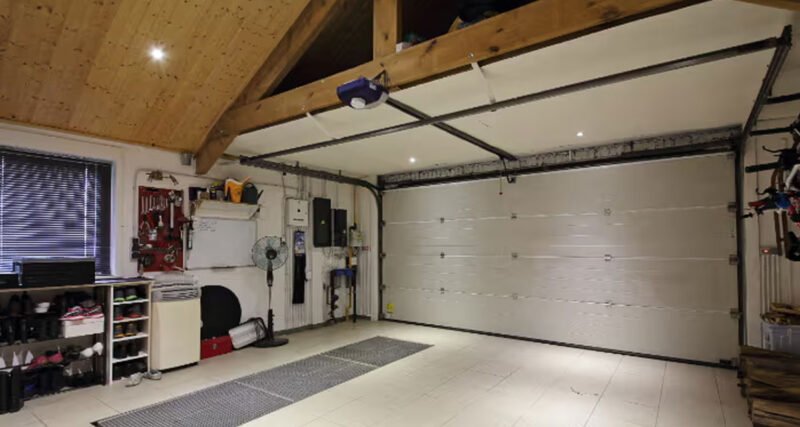
If you are trying to figure out how to reduce noise from garage door hardware, start with the basics. A noisy garage door almost always comes down to three things: loose hardware, dry moving parts, or worn-out components.
Most fixes take under an hour and cost less than $50 in supplies. A few of them are completely free. The trick is knowing which noise points to which problem, because spraying lubricant on a loose bolt does exactly nothing.
Diagnose the Noise First
Different sounds mean different issues, and guessing wrong wastes time. A high-pitched squeak on every open-close cycle points to dry rollers or hinges. A metallic rattle that comes and goes usually means a bolt somewhere has worked itself loose.
Grinding or scraping, especially if the door hesitates mid-travel, signals misaligned tracks or worn opener gears. And a single loud bang when the door starts moving typically means a broken spring, which is not a DIY job.
| Sound | Likely Cause | Fix | Time |
|---|---|---|---|
| Squeaking or creaking | Dry rollers, hinges, or springs | Lubricate with silicone spray or lithium grease | 15 min |
| Rattling or vibrating | Loose nuts, bolts, or brackets | Tighten all hardware with socket set | 20 min |
| Grinding or scraping | Misaligned tracks or worn opener gears | Realign tracks; replace opener gear kit | 30 to 90 min |
| Loud bang on startup | Broken torsion or extension spring | Call a professional. Do not attempt DIY. | Pro only |
| Humming through ceiling | Opener motor transmitting vibration to framing | Install isolator kit or rubber mounting pads | 30 min |
Start with the cheapest fix first. Tightening hardware costs nothing and solves more noise problems than most people expect.
Tighten Everything First: It Is Free
A standard overhead garage door has well over 100 nuts, bolts, and screws holding it together. After years of daily cycles (a typical door opens and closes roughly 1,500 times a year), vibration gradually loosens those fasteners. What starts as a faint rattle eventually becomes a full percussive performance every time the door moves.
Grab a basic socket set and a wrench. Work your way around the entire door: hinge brackets, roller brackets, track mounting bolts, and the opener mounting hardware on the ceiling. Turn each one clockwise until snug. The ceiling brackets for the opener motor are especially prone to loosening. If the motor unit itself wobbles while running, that vibration transmits straight through the framing into bedrooms above the garage.
Do not overtighten. You want bolts firm, not torqued to the point of stripping threads or warping the metal track. A quarter-turn past hand-tight is usually enough. If a bolt keeps spinning without grabbing, the hole may be stripped. Replace it with a slightly larger self-tapping screw or add a nut on the back side.
“Garage Door Tech Here — Why Your Door Is So Loud (And What Usually Causes It)”
— r/fixit, 449 upvotes, 101 comments (2025), source
That thread alone, posted by an actual garage door technician, generated over a hundred comments from homeowners who discovered their noise problem was nothing more than loose hardware they had never thought to check.
How to Lubricate a Garage Door the Right Way
The single biggest lubrication mistake is reaching for WD-40. It is a water displacer and solvent, not a lubricant. It strips away whatever remaining grease is on the parts and then evaporates, leaving metal-on-metal contact that is louder than before you started. Use a silicone-based spray lubricant or white lithium grease instead. Both are available at any hardware store for under $10.
Apply lubricant to four contact points:
- Rollers. Spray where the roller meets the stem, not on the track itself. If your rollers are nylon, lubricate only the metal ball bearings inside; silicone degrades nylon over time.
- Hinges. Each hinge has a pivot point between the door panels. A quick shot on each hinge pin quiets the creaking that builds up as panels flex during the open-close cycle.
- Springs. For torsion springs (the horizontal bar above the door), spray along the coils while the door is closed. Extension springs on the sides need lubrication where the coils rub against each other under tension.
- Opener chain or screw drive. A light coat on the chain or screw drive rail. Skip this step entirely if you have a belt-drive opener. Belt drives need no lubrication and adding any product will degrade the rubber.
Wipe off excess lubricant with a rag after application. A visible film attracts dirt, and dirt turns a lubricated joint into an abrasive paste. Repeat the process every six months. Set a calendar reminder, because this is the single easiest thing to forget and the single most effective noise reducer you can do yourself.
Upgrades That Make a Permanent Difference
If you have tightened everything and lubricated properly and the door still sounds like a freight train, one or more components have reached the end of their service life. These upgrades are ranked from cheapest to most expensive, and each one makes a measurable difference in noise reduction.
| Upgrade | Typical Cost | Noise Reduction | DIY or Pro? |
|---|---|---|---|
| Nylon rollers with sealed ball bearings | $10 to $20 per roller (10 to 12 total) | Major: eliminates metal-on-metal roller noise | DIY if comfortable removing hinge brackets; otherwise pro |
| Belt-drive opener replacing chain drive | $170 to $350 for the unit | Major: chain slap and motor vibration cut dramatically | Pro installation recommended |
| Opener vibration isolator kit | $50 to $150 | Moderate: decouples motor vibration from ceiling framing | DIY, 30 minutes |
| Torsion spring conversion from extension springs | $200 to $400 installed | Moderate: torsion springs run much quieter | Pro only, spring tension is dangerous |
| Insulated garage door replacing uninsulated door | $1,200 to $4,700 | Moderate: dampens door panel vibration and outside noise | Pro installation |
Nylon rollers with sealed ball bearings are the best value upgrade by a wide margin. Steel rollers transmit every imperfection in the track as vibration and noise. Nylon rollers absorb that vibration and roll nearly silently. Expect to pay $10 to $20 per roller, and a standard double-wide door uses 10 to 12 rollers total.
If you are comfortable removing hinge brackets one at a time, this is a manageable DIY project. If the bottom roller brackets are under spring tension, leave those to a professional. The tension in a garage door spring can cause serious injury if released incorrectly.
Belt-drive openers replace the metal chain with a reinforced rubber belt. The difference in noise is dramatic: a chain drive rattles and clanks through every cycle, while a belt drive produces a low hum that is barely audible from the room directly above the garage.
Most major manufacturers (LiftMaster, Genie, Chamberlain) offer belt-drive models, and the cost difference over a chain drive is typically $50 to $100 for a much quieter decade of operation.
Soundproofing Beyond the Door Itself
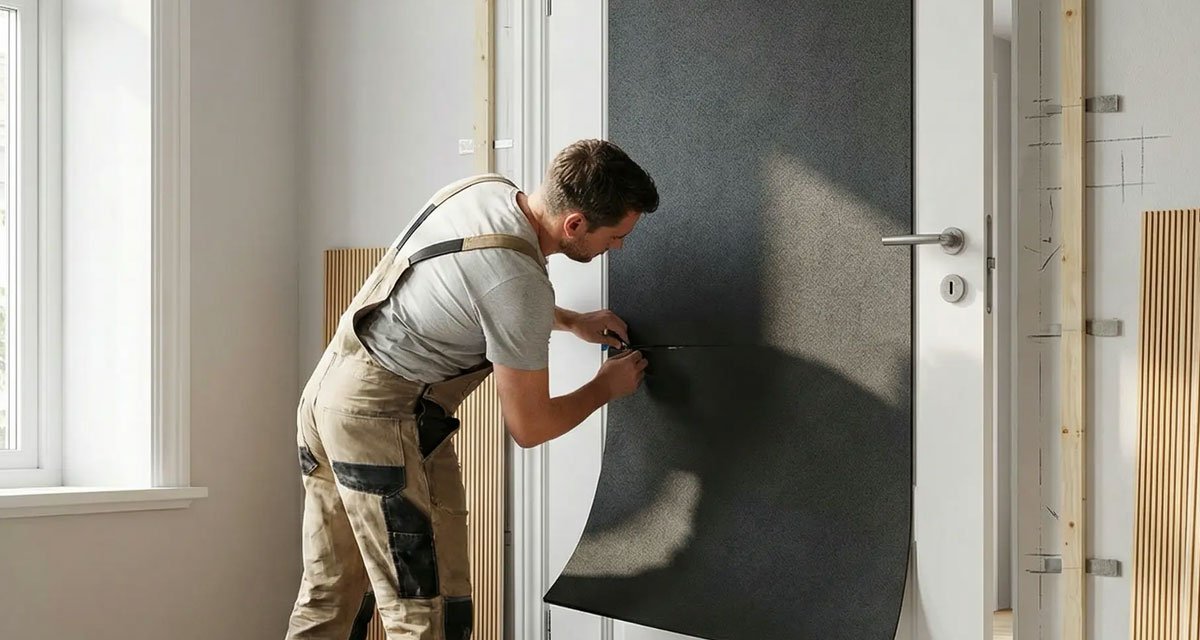
Sometimes the door mechanism is quiet but the garage itself acts as an echo chamber that amplifies every vibration. An opener isolator kit addresses this directly. It places rubber bushings between the motor unit and the metal mounting bracket, breaking the physical path that transmits motor vibration into the ceiling joists. Installation takes about 30 minutes with basic tools.
Adding insulation panels to an existing uninsulated door helps in two ways: the added mass dampens the door’s own vibration, and the insulation absorbs sound that would otherwise reflect off the bare metal panels and out through the garage. Polystyrene foam panels cut to size and inserted into the door’s frame channels cost $50 to $100 for a standard two-car door, far less than replacing the entire door.
If the garage shares a wall with living space, also check the weather stripping around the door perimeter. Gaps let noise escape as easily as they let cold air in. Replace cracked or compressed weather stripping with a fresh rubber seal.
When to Call a Professional
Three situations are not DIY territory. A broken spring, especially a torsion spring under several hundred pounds of tension, can cause life-threatening injury if it snaps while you are working on it.
Misaligned tracks that require loosening the track mounting brackets and repositioning them also carry risk, because the door’s weight shifts unpredictably when the track is unfastened. And any repair that requires removing the bottom roller bracket involves the spring cable system, which is under constant high tension.
For anything involving springs, expect to pay around $250 for a spring replacement from a local garage door company. The cost of a professional service call, usually $75 to $150, is a rounding error compared to an emergency room visit.
Frequently Asked Questions
Can I use WD-40 on a garage door?
No. WD-40 is a solvent and water displacer, not a lubricant. It strips existing grease and evaporates quickly, leaving metal parts running dry. Use a silicone-based spray lubricant or white lithium grease instead. Both cost under $10 and provide lasting lubrication designed for metal-on-metal contact under load.
How often should I lubricate my garage door?
Every six months. Set a recurring calendar reminder, because this is the single most effective maintenance task for noise reduction and it takes less than 15 minutes. If you live in a coastal area with salt air or a region with extreme temperature swings, lubricate every three to four months instead.
Are nylon rollers really quieter than steel?
Yes, by a significant margin. Steel rollers transmit every track imperfection as vibration and metallic noise. Nylon rollers with sealed ball bearings absorb that vibration and roll nearly silently. The upgrade costs $100 to $240 for a full set of 10 to 12 rollers and is the single best hardware upgrade you can make for noise reduction.
How much does a noisy garage door cost to fix?
Most noise fixes cost under $50 for DIY supplies: a can of silicone lubricant, a socket set if you do not already own one, and a tube of lithium grease.
If components need replacing, nylon rollers cost $100 to $240 for a full set, a belt-drive opener runs $170 to $350, and professional spring replacement averages $250. The majority of noise problems are solved by tightening hardware and applying the right lubricant, both of which are effectively free.
Why is my garage door noisier in winter?
Cold temperatures cause metal components to contract, which tightens clearances and increases friction between moving parts. Lubricants also thicken in cold weather, reducing their effectiveness. The same door that runs quietly in July can squeak and groan in January. Switching to a low-temperature silicone lubricant and ensuring all hardware is properly torqued helps minimize seasonal noise swings.
A Maintenance Schedule That Actually Works
Write this down or set phone reminders. Twice a year: lubricate rollers, hinges, springs, and opener chain. Check every visible bolt and tighten anything that has worked loose. Once a year: inspect rollers for wear. If they wobble or have flat spots, replace them.
Listen to the door during a full open-close cycle and compare the sound to what it made six months earlier. Changes in noise character, from a smooth hum to a grinding sound or from quiet to a new rattle, are early warnings that something is wearing out. Catching those warnings early is what turns a $10 fix into a $250 repair you never had to make.