

Just as researching the Best Areas Invest San Antonio requires due diligence, detecting mold behind walls requires attention to persistent musty smells, unexplained allergy flare-ups, bubbling paint, and a history of water leaks. Catching it early saves thousands in remediation costs and protects your household from respiratory problems.
Catching it early saves thousands in remediation costs and protects your household from respiratory problems linked to prolonged mold exposure. Below is a practical detection process, from sensory checks you can do right now to professional-grade tools that confirm what your nose already suspects.
Warning Signs of Mold Behind Walls
The most reliable early indicator is a musty, earthy odor that intensifies near a specific wall, closet, or corner. Surface-level clues like discoloration, peeling paint, or warped baseboards often follow. If household members develop unexplained respiratory symptoms, the wall cavity is the first place to investigate.
Musty or Earthy Odor
Mold releases microbial volatile organic compounds (MVOCs) as it feeds on damp drywall and wood framing. These compounds produce the distinctive “old basement” smell that lingers even after cleaning. Walk through each room slowly with windows closed. If one room or one wall consistently smells different, moisture and mold behind that wall become a real possibility.
The odor tends to spike in humid weather and after hot showers. Bathrooms, laundry rooms, and walls that share plumbing are the usual culprits.
Visible Surface Clues
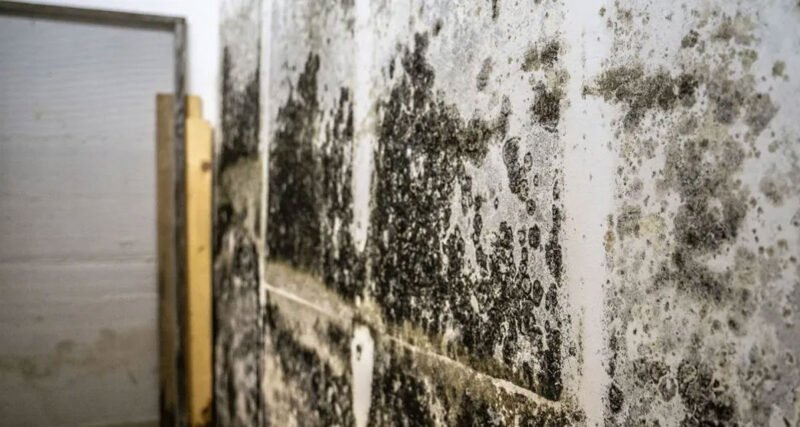
Paint that bubbles, cracks, or peels without an obvious cause often signals trapped moisture underneath. Dark streaks, yellowish stains, or ring-shaped water marks on drywall point to a leak that may have been feeding mold for weeks. Wallpaper that pulls away from the wall at the seams is another flag.
Press your palm against the suspicious area. Drywall that feels soft, damp, or spongy has absorbed enough water to support active mold colonies on its backside.
Physical Health Symptoms
The CDC reports that people living in damp, mold-affected homes experience higher rates of upper respiratory tract symptoms, coughing, and wheezing. Household members with asthma or allergies tend to notice symptoms first: itchy eyes, a runny nose that never quite clears up, headaches that fade when leaving the house.
“Found heavy mold behind bathroom wall! how bad is this? Could it explain months of shortness of breath/chest tightness?”
— r/Home, 789 upvotes, 257 comments (2025), source
This aligns with guidance from the CDC’s National Center for Environmental Health, which confirms that prolonged exposure to indoor mold can cause persistent respiratory symptoms even in otherwise healthy adults.
That family had lived with unexplained breathing problems for months. The answer turned out to be three feet behind their bathroom mirror.
DIY Methods to Detect Mold Behind Walls
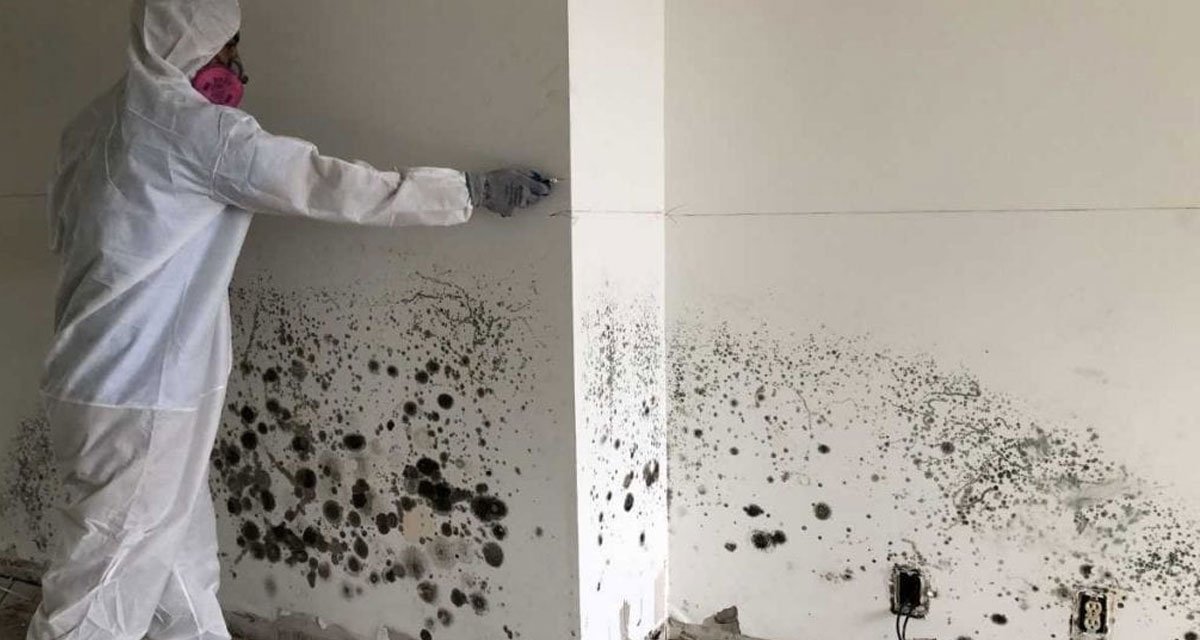
A $30 to $50 moisture meter is the single most effective DIY tool for finding hidden mold. Readings above 17% moisture content in drywall strongly suggest a moisture problem and potential mold growth. Pair it with a simple smell test and an over-the-counter test kit for a thorough check before calling a professional.
The Smell Test
Close all windows and doors in the suspect room for a few hours. Then re-enter and breathe normally. Your nose picks up MVOCs at concentrations as low as parts per billion. Focus on interior closets, behind furniture pushed against exterior walls, and along baseboards. The musty smell usually concentrates within a few feet of the actual mold colony.
Moisture Meter Testing
Pin-type moisture meters push two small probes into the drywall surface. They leave tiny marks but give precise readings. Pinless meters scan a broader area without any damage. For drywall, a reading under 12% is normal. Between 12% and 17% warrants monitoring. Above 17% almost always means water is actively present, and mold is likely growing or about to start.
Scan the wall in a grid pattern. Start at the floor and work upward, marking any spot where readings spike. A pattern of high readings near a pipe run or window frame narrows down the moisture source quickly.
DIY Mold Test Kits
Home mold test kits fall into two categories: air sampling cassettes and surface swab kits. Air sampling kits capture airborne spores over 24 to 48 hours and send the cassette to a lab for analysis, typically costing $30 to $50 including lab fees. Surface swab kits test a specific area and return results in minutes, though they only confirm mold on accessible surfaces.
Neither replaces a professional inspection. Lab-analyzed air samples give spore type and concentration data, but a high spore count in one room compared to outdoors is the meaningful indicator.
| Detection Method | Cost | Accuracy | Invasiveness | Skill Level |
|---|---|---|---|---|
| Smell test | Free | Low (screening only) | None | Beginner |
| Moisture meter | $30-$50 | Medium-High | Minimal (pin marks) | Beginner |
| DIY air test kit | $30-$50 | Medium | None | Beginner |
| Thermal imaging | $300-$600 (pro) | High | None | Professional |
| Borescope camera | $50-$200 (DIY) / included in pro inspection | Very High | Small drill hole | Intermediate |
| Professional air quality test | $200-$500 | Very High | None | Professional |
A $35 moisture meter that reveals 22% readings at your bathroom wall could save you from a $12,000 remediation bill discovered six months later.
Professional Detection Techniques
Professional mold inspectors use thermal imaging cameras and borescope cameras to locate mold behind walls without cutting into drywall. A standard inspection runs $300 to $600 depending on the size of the home and the number of samples taken.
Thermal Imaging
FLIR and similar infrared cameras detect temperature differences across a wall surface. Moisture-laden areas appear as cool blue patches against the warmer surrounding drywall. The camera does not “see” mold directly, but it pinpoints exactly where moisture has accumulated, and where moisture persists, mold follows.
According to the American Society of Home Inspectors (2024), thermal imaging identifies hidden moisture sources with over 90% accuracy when used by a trained inspector. The scan takes minutes and requires zero wall penetration.
Borescope Inspection Cameras
A borescope is a flexible camera on a thin cable, inserted through a small hole drilled in the drywall. It provides direct visual confirmation of mold colonies, water stains, and damaged insulation inside the wall cavity. The drill hole is about the diameter of a pencil and patches easily.
Air Quality Testing
Certified inspectors collect air samples from inside the home and compare spore concentrations against an outdoor control sample. Elevated indoor spore counts, especially of species like Stachybotrys (black mold) or Aspergillus, confirm active mold growth even when no visible colony has been found.
“Help! Bought house 2 months ago and found THIS behind the wall paint…”
— r/Mold, 327 upvotes, 119 comments (2025), source
Home inspections before purchase do not always include mold testing. A dedicated mold inspection adds $300 to $600 but can reveal problems that a standard home inspection misses entirely.
What Causes Mold to Grow Behind Walls
Mold starts growing behind walls when trapped moisture from leaks, condensation, or flooding stays wet for more than 24 to 48 hours in an area with poor airflow. Drywall and wood framing absorb water like a sponge, creating an ideal feeding ground.
Common Moisture Sources
Slow plumbing leaks are the most frequent cause. A pinhole drip at a pipe joint behind the shower wall can feed a mold colony for months before anyone notices. Roof leaks, window flashing failures, and condensation on poorly insulated exterior walls account for most of the remaining cases.
Indoor humidity above 60% accelerates the problem. The EPA recommends keeping indoor humidity between 30% and 50% year-round. Bathrooms without exhaust fans and basements with no dehumidifier routinely exceed that threshold.
Why Walls Trap Moisture
Modern wall construction sandwiches moisture-sensitive materials between two vapor barriers. Once water gets in, it has nowhere to go. Insulation holds the moisture against the drywall backing, and with no air circulation inside the cavity, the conditions stay wet indefinitely.
Most homeowners who discover extensive mold behind their walls say the leak had been active for months, sometimes years. The slow, invisible kind of drip that seems too small to matter until the remediation estimate lands in five figures.
When to Call a Professional vs. DIY
Call a professional mold inspector if the suspected affected area exceeds 10 square feet, you smell mold but cannot locate a visible source, or anyone in the household has developed unexplained respiratory symptoms. The EPA uses 10 square feet as the threshold below which most homeowners can handle cleanup themselves.
Cost Comparison
| Service | Typical Cost | What You Get |
|---|---|---|
| DIY mold test kit | $10-$50 | Basic spore presence confirmation |
| Professional mold inspection | $300-$600 | Thermal imaging, air sampling, lab analysis, written report |
| Mold remediation (small area) | $1,500-$3,500 | Containment, removal, cleaning, preventive treatment |
| Mold remediation (large area) | $3,500-$9,000+ | Full wall demo, HEPA filtration, reconstruction |
Most standard homeowners insurance policies do not cover mold remediation unless the mold resulted from a “covered peril” like a burst pipe. Mold from ongoing humidity or deferred maintenance is typically excluded. Check your policy before assuming coverage.
Frequently Asked Questions
Can mold behind walls make you sick?
Yes. Mold behind walls releases spores and MVOCs into indoor air, which can cause coughing, wheezing, nasal congestion, eye irritation, and headaches. People with asthma, allergies, or compromised immune systems face higher health risks from prolonged exposure, according to the CDC.
How much does it cost to test for mold behind walls?
DIY test kits cost $10 to $50. A professional mold inspection with thermal imaging and lab-analyzed air samples typically runs $300 to $600. The professional route provides species identification and a detailed report, which is often required for insurance claims or real estate transactions.
Does homeowners insurance cover mold behind walls?
Most policies cover mold only if it results from a sudden, covered event like a burst pipe. Mold caused by humidity, condensation, or long-term neglected leaks is usually excluded. Some insurers offer mold endorsements for an additional premium, typically capping coverage at $5,000 to $10,000.
“Mold question – can’t see it behind wall, can we still have a problem?”
— r/homeowners, 2 upvotes, 9 comments (2025), source
Absolutely. Mold thrives in dark, damp wall cavities long before it becomes visible on the surface. A musty smell or elevated moisture meter readings are reason enough to investigate further.
Can you paint over mold on walls?
Painting over mold does not kill it. The colony continues growing beneath the paint layer and will eventually push through again. Mold-resistant paint works as a preventive coating on clean surfaces, not as a treatment for existing mold. Remove the mold first, then repaint.
How fast does mold grow behind wet drywall?
Mold spores can colonize damp drywall within 24 to 48 hours under favorable conditions (temperatures between 77 and 86 degrees Fahrenheit, humidity above 60%). Visible growth typically appears within 1 to 2 weeks if the moisture source is not addressed.
Take Action Before the Problem Grows
A musty smell, surface discoloration, and moisture meter readings above 17% are the three clearest signals that mold is hiding behind your walls. Start with a room-by-room smell check and a $35 moisture meter. If readings come back high or the smell persists without a visible source, schedule a professional inspection before a small problem becomes a major remediation project.
The cost of early detection is a fraction of what delayed action demands.