



According to the quality of tenants you attract, repairing a vinyl siding corner is different from repairing a damaged panel. The corner post is the vertical trim piece that receives the ends of the siding panels from both walls. It is not interlocked with the panels the way panels interlock with each other. The panel ends slide into the corner post channel and are free to expand and contract within it. The corner post is nailed to the wall through its nailing flange at the top of the uppermost slot, and it hangs from that nail. The rest of the slots allow the post to expand downward. To replace a damaged corner post, you remove the old one, slide a new one into place behind the existing panel ends, and nail it at the top.
Corner posts get damaged by impact, by heat, and by age. A lawn mower throws a rock. A ladder leans against the corner and cracks the plastic. A grill placed too close warps the post. The vinyl becomes brittle after 20 years of sun exposure and cracks when something brushes against it. The repair is the same regardless of the cause. Remove the damaged post. Install a new one. The challenge is getting the new post behind the siding panels without removing them. The panels are already cut to length and locked into the panels above and below. They do not need to be removed. The corner post slides out from behind them and the new post slides in.
Replacing a Damaged Outside Corner Post
The outside corner post is the trim piece at every external corner of the house. It has a nailing flange on each side, a channel on each side that receives the siding panel ends, and a visible face that wraps around the corner. The replacement post must match the profile and color of the existing post. Take the old post or a photograph of it to the store. Corner posts are available in different profiles, widths, and colors. A mismatched corner post is visible from across the street.
Remove the damaged corner post by pulling the nails from the nailing flanges. The nails are typically at the top of the uppermost slot on each side. Use a flat pry bar or a cat’s paw nail puller. Work the nail out gently. The vinyl flange will tear if you pull too hard. If the nail is rusted and the flange begins to tear, cut the nail with a hacksaw blade rather than risk tearing the flange beyond the nail slot. The top nail is the only one that holds the post. The nails in the lower slots are driven loosely to allow movement and will slide out easily.
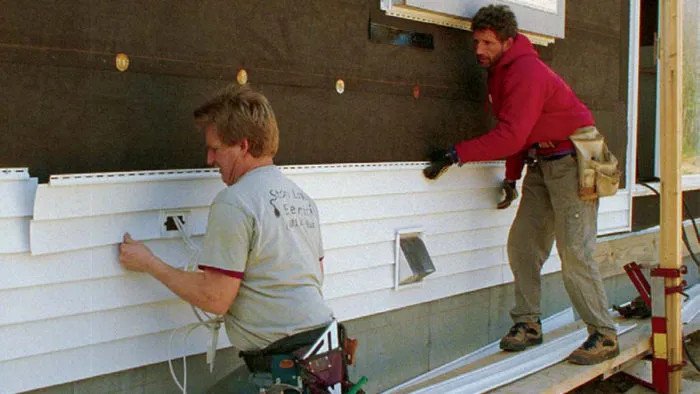
Once the nails are removed, slide the damaged post down and out from behind the siding panels. The panel ends will remain in place, sticking out past the corner. The new post slides up from the bottom, behind the panel ends. This is the difficult part. The panel ends must be guided into the channels on both sides of the new post simultaneously. Start at the bottom and work the post up, feeding the panel ends into the channels as you go. A helper makes this easier. One person holds the panel ends slightly away from the wall while the other slides the post up. Work slowly. The panel ends are cut to fit inside the corner post channel with room for expansion. They will fit if you guide them in gently. Do not force them. Forcing can crack the panel ends or bend the corner post channel.
Once the post is in position, nail it through the top of the uppermost slot on each side. The nail must be loose enough that the post can slide under the nail head. The dime-gap rule for vinyl siding panels applies to corner posts as well. The post must be able to expand downward. Do not nail through any of the lower slots. The post hangs from the top nail and is free to move below it. Nailing through lower slots restrains the post and causes it to buckle when it expands.
Repairing Inside Corner J-Channel
Inside corners on vinyl-sided houses are typically finished with J-channel rather than a corner post. The J-channel from each wall butts into the corner. The siding panels slide into the J-channel on each wall. Repairing damaged J-channel at an inside corner is simpler than replacing an outside corner post because J-channel is smaller, lighter, and does not wrap around the corner. Remove the damaged section of J-channel by pulling the nails from the nailing flange. Cut a new piece of J-channel to length. Slide it into place behind the siding panel ends. Nail through the nailing flange slots, leaving the dime-gap for expansion.
If the J-channel at the inside corner is damaged where the two walls meet, you may need to replace the J-channel on both walls. The pieces meet at the corner and the damage often extends across the corner line. Replace both pieces. Cut them to length so they meet cleanly at the corner. The piece on one wall can extend slightly past the corner and the piece on the other wall butts into it, or both pieces can be cut at 45 degrees to form a mitered corner. The overlap method is simpler and more common.
Frequently Asked Questions
How do I match a replacement corner post to 20-year-old siding?
You cannot perfectly match a new corner post to faded siding. The new post will be darker and more saturated than the surrounding panels. The mismatch at a corner is less noticeable than a panel replacement in the middle of a wall because the corner is a natural visual break. If the mismatch is unacceptable, paint the corner posts and any other trim pieces with acrylic latex paint in a color that matches the faded siding as closely as possible. The paint will fade over time and the mismatch will become less noticeable.
Do I need to remove the siding panels to replace a corner post?
No. The siding panels slide into the corner post channel but are not fastened to it. The panels are held in place by the panels above and below them and by the J-channel at the other end. The corner post can be removed without disturbing the panels. The new post slides in behind the panel ends.
Can I repair a cracked corner post without replacing it?
A small crack can be sealed with clear exterior silicone caulk. The caulk will prevent water from entering the crack and will hold the pieces together. The repair will be visible on close inspection. A large crack, a missing piece, or a warped post should be replaced. Caulk cannot restore the structural integrity of a post that has been significantly damaged, and a warped post will not accept the siding panel ends properly in its channel.
The Bottom Line
Vinyl siding corner posts hang from a single nail at the top of each side and receive the ends of the siding panels in their channels. To replace a damaged corner post, pull the top nails, slide the old post down and out, slide the new post up behind the panel ends, and nail through the top of the uppermost slots. The panel ends do not need to be removed. The corner post does the work of hiding the panel ends and framing the corner. The repair takes an hour and a trip to the store for a matching post. The result is a corner that looks like it was never damaged.