



A pallet fence costs $2 to $5 per linear foot in materials compared to $15 to $30 for a cedar privacy fence and $10 to $20 for chain link, shares the Campus Realtors Baylor team. The pallets themselves are free or cost a few dollars each. The posts, concrete, screws, and sealer are the only purchased materials. A 50-foot pallet fence can be built for $150 to $300, roughly the cost of two prefabricated cedar fence panels.
The trade-off is time, variability, and lifespan. Building a pallet fence takes two to three times as long as assembling a prefabricated fence because each pallet must be inspected, cleaned, and potentially disassembled before it can be attached to the posts. The pallets are not uniform. The boards vary in width, the gaps vary in size, and the overall look is rustic rather than polished. A pallet fence lasts 5 to 10 years with proper sealing and maintenance, compared to 15 to 25 years for a cedar fence. For a garden enclosure, a dog run, or a temporary fence that you want to look intentional rather than improvised, pallets are a legitimate building material. Here is how to source the right pallets, prepare them, and build a fence that stands straight and lasts.
Finding and Selecting the Right Pallets
Use only heat-treated pallets marked with the letters HT stamped or branded on the wood. HT means the pallet was sterilized with heat, not with methyl bromide, a toxic fumigant. Avoid pallets stamped MB. Avoid pallets that are stained with oil, grease, or unknown chemicals. Avoid pallets that have carried fertilizers, pesticides, or industrial products. The stamp is usually on the side of the pallet stringer or on one of the deck boards.
Look for pallets made of hardwood. Oak pallets are heavier, denser, and last years longer than pine pallets. Oak is used for shipping heavy industrial goods including machinery, tile, and stone. Pine pallets are lighter and easier to work with but rot faster when in ground contact. For the fence boards that will be exposed to weather, hardwood pallets are worth the extra effort to find and disassemble.
Sources for free pallets include construction sites where materials are delivered on pallets that are discarded after the materials are unloaded. Industrial parks and warehouse districts where pallets accumulate at loading docks. Hardware stores and garden centers that receive bulk deliveries. Online marketplaces including Craigslist and Facebook Marketplace where businesses give away pallets to avoid disposal fees. Always ask permission. Pallets behind a business are property, not free material.
For a 50-foot fence at 4 feet tall, you need approximately 25 to 35 standard 40-by-48-inch pallets depending on whether you use them intact or disassemble them for the individual boards. Collect 10 to 20 percent more than you calculate to account for damaged boards and pallets that turn out to be unusable once you inspect them closely.
Design Options: Intact Pallets vs. Disassembled Boards
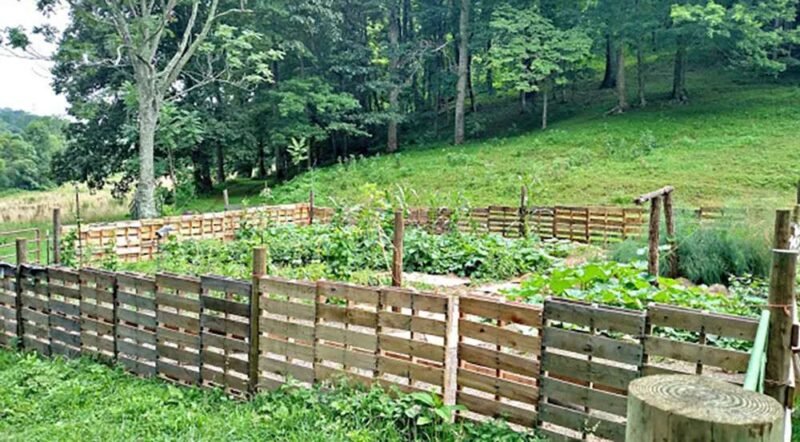
Intact pallets are the faster method. Each pallet is attached to the fence posts as a complete panel. The pallet’s existing boards become the fence face. The gaps between the boards provide partial visibility and wind permeability, which is an advantage in windy locations where a solid fence would act as a sail. Intact pallets produce a fence with a repeating panel pattern that reads as intentional design rather than a pile of pallets leaning against posts.
Disassembled boards are the slower method that produces a more traditional fence appearance. Each pallet is taken apart, the individual boards are sorted by quality, and the best boards are attached to horizontal rails between the posts. The result looks more like a conventional wood fence, albeit with boards of varying widths and colors. Disassembling pallets is the most labor-intensive part of the project. A single pallet takes 10 to 20 minutes to disassemble with a pallet buster or a reciprocating saw. For 30 pallets, the disassembly alone is 5 to 10 hours of work.
Set the Posts First
The posts are the permanent structure. The pallets are the replaceable surface. Set the posts in concrete below the frost line, following the same procedure as for any fence post. Use 4-by-4 pressure-treated posts spaced 40 or 48 inches apart to match the pallet width plus the post width. A standard pallet is 40 by 48 inches. If the pallets are used intact and oriented vertically, the 40-inch width determines the post spacing. If the pallets are disassembled and the boards run horizontally between posts, 8-foot post spacing is standard, and the boards span between posts like a traditional fence.
For a fence that will be exposed to soil contact at the base, the posts must be pressure-treated or naturally rot-resistant like cedar. The pallet boards themselves should not contact the ground. Leave a 2 to 4-inch gap between the bottom of the lowest pallet board and the ground. The gap prevents the pallet wood from absorbing moisture from the soil and rotting from the bottom up. The gap also allows a string trimmer to cut the grass along the fence line without chewing into the fence boards.
For projects involving digging near pre-1978 homes, the EPA recommends containing excavated soil and keeping children and pets away from the work area, as lead paint residue from exterior painting may have accumulated in the surrounding soil over decades.
Attaching the Pallets to the Posts
For intact pallets, stand the pallet on edge between two posts with the deck boards running vertically or horizontally depending on your design. Screw through the pallet stringers, the thick side rails, into the posts using 3-inch exterior deck screws. Two screws per stringer per post. A standard pallet has three stringers. That is six screws per pallet per post. If the pallet is oriented with the stringers vertical, attach the pallet to horizontal rails between the posts instead. The rails are 2-by-4s screwed between the posts at the top, middle, and bottom. The pallet is screwed to the rails.
For disassembled boards, attach horizontal 2-by-4 rails between the posts. The rails run at the top and bottom of the fence, and a third rail in the middle for fences taller than 4 feet. Screw the pallet boards to the rails vertically, leaving a consistent gap between boards for aesthetics and wind permeability. The gap is the width of a 16d nail, approximately 1/8 inch, or wider for a more open look. The boards will shrink as they dry, widening the gap. Install the boards tight butted if you want minimal gap after drying, or spaced from the start if you want a consistent gap year-round.
Sealing and Finishing the Fence
Pallet wood is untreated and will gray, crack, and rot within 2 to 3 years if left unsealed. Apply a penetrating wood sealer or an exterior deck stain to all surfaces of the pallet boards before installation. Sealing before installation coats all six sides of each board, including the ends and edges that will be hidden after the fence is assembled. A fence sealed after assembly has unsealed end grain at every cut, and end grain absorbs water faster than face grain. The difference between a pallet fence that lasts 5 years and one that lasts 10 years is whether the boards were sealed on all sides before they were attached.
Use an exterior penetrating stain or a clear wood sealer with UV inhibitors. Paint is not recommended for pallet wood because the varying moisture content of the different boards causes paint to peel unevenly. A penetrating stain soaks into the wood and does not form a surface film that can peel. Reapply the sealer every 1 to 2 years. A pallet fence requires more maintenance than a cedar fence because the wood is lower quality to begin with. The maintenance is the price of the materials being free.
Pallet Fence vs. Traditional Fence: Cost Comparison
| Item | Pallet Fence (50 ft) | Cedar Fence (50 ft) | Chain Link (50 ft) |
| Fence material | $0–$50 (pallets) | $400–$700 | $200–$400 |
| Posts and concrete | $100–$150 | $100–$150 | $100–$150 |
| Screws and hardware | $25–$50 | $30–$50 | $25–$50 |
| Sealer or stain | $30–$60 | $40–$80 | N/A |
| Total materials | $155–$310 | $570–$980 | $325–$600 |
The pallet fence saves $170 to $670 compared to chain link and $415 to $670 compared to cedar for the same 50-foot run. The savings come from the fence material, which is free or nearly free. The posts, concrete, and hardware cost the same regardless of the fence type. The pallet fence is not free. It is $3 to $6 per linear foot for a fence that costs $7 to $20 per linear foot in other materials. The savings are real but the labor is significantly higher.
Frequently Asked Questions
Should pallet boards run horizontally or vertically?
Vertically is structurally simpler because each board spans from the top rail to the bottom rail without intermediate support. Horizontally requires more rails because the boards span between posts and must be supported every 4 to 6 feet to prevent sagging. Horizontal boards also collect water on the top edge of each board, which accelerates rot. Vertical boards shed water. For a pallet fence that will be exposed to weather, vertical boards last longer. Horizontal boards are appropriate for a decorative fence or a fence under a roof overhang.
Will a pallet fence contain a dog?
It depends on the dog and the fence design. Intact pallets with gaps between the deck boards may have openings large enough for a small dog to squeeze through. The standard gap on a pallet is 3 to 4 inches. A dog that can fit through a 4-inch gap will escape. Adding a second layer of pallet boards offset from the first layer closes the gaps. Disassembled boards installed tight-butted with a gap of 1/8 inch or less will contain any dog that cannot jump the fence height. The fence must also be tall enough. A 4-foot fence contains most medium and large dogs. Small dogs and determined climbers need a taller fence or an inward-angled top.
Will a homeowners association allow a pallet fence?
Probably not. Most HOAs have architectural guidelines that specify approved fence materials, and pallets are not on the list. A pallet fence is appropriate for rural properties, properties without an HOA, and properties where the fence is in the backyard and not visible from the street. If the fence must be approved by an HOA, submit a description and a photo of a completed pallet fence before building. An HOA that sees a finished, well-built pallet fence that is stained and maintained may approve it. An HOA that sees a pile of mismatched pallets nailed to posts will not.