



According to Palatine property management, installing fiber cement board siding is the same process regardless of whose name is on the wrapper. James Hardie is the dominant brand, but CertainTeed, Allura, and GAF all manufacture fiber cement siding that installs with the same techniques. The planks are nominally five-sixteenths of an inch thick, available in widths from four to twelve inches, and come either factory-primed and ready for paint, or factory-finished with a baked-on color that never needs painting. The primed version costs less upfront and requires painting after installation. The factory-finished version, James Hardie calls it ColorPlus, CertainTeed calls it ColorMax, costs more upfront and eliminates the painting step entirely. The installation is identical for both. The decision is whether you want to paint or pay someone else to have done it at the factory.
Fiber cement is the heaviest common siding material. A 12-foot plank of eight-and-a-quarter-inch lap siding weighs roughly 20 pounds. A bundle of 25 planks weighs 500 pounds. The material must be stored flat and dry. Fiber cement absorbs moisture and will warp if stored on edge or left uncovered in the rain. Store bundles on a flat surface, off the ground on lumber stickers, and covered with a tarp that allows airflow. Do not store fiber cement directly on concrete. The concrete transmits moisture into the bottom planks. Carry planks on edge, not flat. A plank carried flat over a long span will crack under its own weight. Carry it like a piece of plywood, on edge with a hand supporting the middle.
Handling, Cutting, and Site Preparation
Fiber cement is brittle when bent but strong in compression. It will support your weight if you step on it when it is laying flat on the ground. It will snap if you try to bend it around a corner. The planks must be handled with care at the ends. Dropping a plank on its corner will break the corner off. A broken corner cannot be repaired. The plank is scrap.
The wall must be prepared the same way for all fiber cement products. The sheathing must be sound. The house wrap must be intact and properly shingled. The windows and doors must be flashed. Fiber cement is installed with a rainscreen gap in some climates, a space between the back of the siding and the face of the house wrap that allows water to drain and the back of the siding to dry. The rainscreen is created by vertical furring strips or a plastic drainage mat installed over the house wrap before the siding goes on. A rainscreen is recommended in wet climates, coastal areas, and anywhere the siding will be exposed to frequent rain. In dry climates, fiber cement can be installed directly over the house wrap.
Cut fiber cement with the same tools regardless of brand: a circular saw with a diamond blade, electric shears, or a guillotine cutter. The dust from all brands is silica dust and requires the same respiratory protection. The cut edges of all brands must be painted, primed, or sealed before installation if the plank is the primed type. Factory-finished planks have the cut edges touched up with the manufacturer’s touch-up paint. The touch-up paint is included with the siding order or sold separately in matching colors.
Installation: The Universal Fiber Cement Method
The installation method is the same across all fiber cement brands. The planks are blind-nailed through the top edge with corrosion-resistant roofing nails or siding nails. The nails must penetrate at least one and a quarter inches into the studs. The nail heads are covered by the bottom edge of the plank above. The bottom edge of the first course rests on a starter strip, which can be a fiber cement starter strip, a wood furring strip, or simply the cut edge of a piece of fiber cement lap siding installed upside down as a starter.
Butt joints between planks must be gapped one-eighth of an inch and flashed. The gap allows for minor expansion. A piece of aluminum or painted metal flashing behind each butt joint prevents water from penetrating. The joint is caulked with elastomeric caulk after installation. Factory-finished planks use color-matched caulk supplied by the manufacturer. Primed planks use paintable caulk that will be covered by the finish paint.
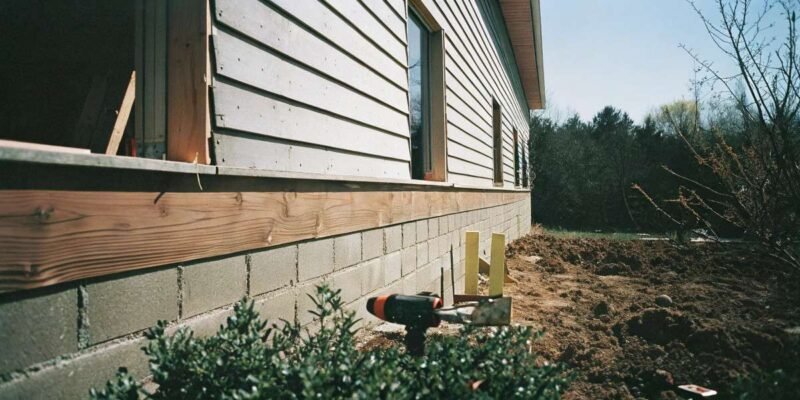
Field cuts around windows, doors, and at gable ends are made with the same tools used for crosscuts. The gap between the siding and trim is one-eighth of an inch for all fiber cement products. The gap at the bottom of the wall above grade is a minimum of six inches. The gap at the top of the wall below the soffit is one-quarter inch. Every gap is caulked or left open depending on its location. Gaps at trim are caulked. Gaps at the bottom of the wall above grade are left open to allow drainage. Gaps at the intersection of siding and roofing are left open and flashed with step flashing.
Frequently Asked Questions
Is there a difference between fiber cement brands for installation?
The installation is nearly identical across brands. James Hardie, CertainTeed, Allura, and GAF fiber cement planks all install with blind nailing, one-eighth-inch butt joints, and the same expansion gaps. The differences are in the available widths, textures, and factory finish options. The manufacturer’s installation instructions are the final authority. Follow the instructions that come with the siding you buy. The instructions from one brand are not necessarily valid for another brand, even though the techniques are similar.
Is factory-finished fiber cement worth the extra cost?
Factory-finished fiber cement, James Hardie ColorPlus or CertainTeed ColorMax, costs roughly 20 to 30 percent more than primed planks. The finish is a baked-on acrylic coating applied at the factory under controlled conditions. It is more uniform and more durable than a field-applied paint job. It does not need to be painted after installation. The elimination of the painting step saves several days of labor and the cost of paint. If you are paying a contractor to install and paint the siding, the factory-finished option is often cost-neutral or slightly cheaper when the painting labor is included. If you are installing the siding yourself and painting it yourself, primed planks are less expensive.
How should fiber cement siding be stored before installation?
Store fiber cement flat, off the ground on lumber stickers, in a dry location. Cover with a tarp that allows airflow. Do not store directly on concrete. Do not store on edge. Do not leave uncovered in the rain. Fiber cement that gets wet before installation must be allowed to dry completely before it is installed. Installing wet fiber cement traps moisture behind the siding and can cause paint failure and warping. If the siding was delivered wet, spread the planks out and let them dry for 24 to 48 hours before installation.
The Bottom Line
Fiber cement board siding is a category that includes multiple brands and two finish options: primed and factory-finished. The installation is blind-nailing, one-eighth-inch gaps, flashed butt joints, and elastomeric caulk, regardless of brand. The material is heavy, brittle at the edges, and must be stored flat and dry. The dust is silica and requires a respirator. The cut edges must be sealed. The wall underneath must be properly flashed and wrapped. Fiber cement is a premium siding material that produces a premium result when installed according to the manufacturer’s instructions and a failure when the instructions are ignored. The instructions that come in the box override any advice in any guide. Read them. Follow them. The siding will outlast the mortgage.