


Replacing the rollers on a sliding glass door is the repair that fixes a door that has become difficult to open. The door that used to slide with one finger now requires two hands and a hip check. The rollers at the bottom of the door are worn out. The bearings are seized. The wheels are flattened on one side from years of rolling back and forth on the same track. The rollers are the only moving parts on a sliding door other than the lock. When they fail, the door becomes a stationary glass wall that happens to have a handle.
The replacement takes an hour. Most of that hour is spent lifting the heavy door panel out of the track and setting it back in. The roller replacement itself is two screws per roller. The adjustment after installation is another five minutes of turning an adjustment screw with a screwdriver until the door slides smoothly and the gap around the frame is even. The rollers cost $10 to $30 per pair. The alternative is replacing the entire door, which costs $500 to $1,500. A door that is hard to open is not a reason to replace the door. It is a reason to replace the rollers.
A sliding door that does not close fully leaves a gap that wastes energy and lets in drafts. ENERGY STAR notes that air leaks around doors and windows can significantly increase heating and cooling costs. Replacing worn rollers restores the door’s ability to seal properly against the weatherstripping.
Step 1: Identify the Roller Type and Obtain Replacements
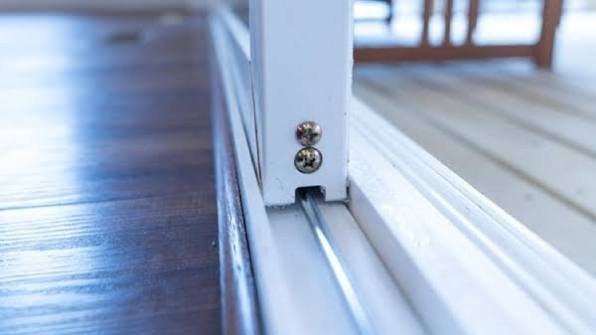
There are two common roller types for residential sliding glass doors. The first is a steel or nylon wheel mounted in a metal housing that screws to the bottom of the door panel. The housing is visible at the bottom edge of the door. The adjustment screw, typically a Phillips or flathead screw, is accessible through a hole in the bottom edge of the door or through a removable cover on the face of the door near the bottom. The second type is a tandem roller assembly with two wheels mounted side by side in a single housing, used on heavier doors. The tandem assembly is wider and requires a larger cutout in the bottom of the door.
Identify the roller type before removing the door. Look at the bottom edge of the door panel. If you see a small metal housing with a wheel, that is a single roller. If you see a wider housing with two wheels, that is a tandem. Take a photograph. Remove one roller after the door is out and take it to the hardware store. Match the old roller to the new one. The dimensions, the wheel diameter, the housing width, and the mounting hole spacing must match. A roller that looks similar but is slightly different will not fit. If you cannot find an exact match at a home center, order from a window and door parts supplier. The manufacturer’s name is often stamped on the door frame or the glass. A door from a known manufacturer can be matched by model and year.
Step 2: Remove the Door Panel
Remove the sliding panel from the track. Unlock the door and slide it to the center of the opening. Locate the adjustment screw holes at the bottom of the door on the face or the bottom edge. Turn the adjustment screws counterclockwise to retract the rollers fully into the door. This lowers the door panel and gives you the clearance to lift it out of the track.
Lift the door panel into the upper track. The top of the door has a channel that the upper guide or the top rail rides in. Push the panel upward until the bottom clears the lower track. Swing the bottom of the panel outward into the room. Lower the panel and lift it out of the opening. The sliding panel weighs 60 to 100 pounds. Have a helper. Set the panel on a pair of sawhorses or a padded surface, resting on its edge with the bottom facing you. Do not lay the door flat on its face. The glass can crack under its own weight if the door is laid flat and unsupported in the middle.
Step 3: Replace the Rollers and Adjust
Remove the old rollers. Each roller is held in place by one or two screws through the housing into the bottom edge of the door. Remove the screws. The roller assembly pulls out of the bottom of the door. If the roller is stuck, spray it with penetrating oil and let it sit for a few minutes. Old rollers can be corroded in place.
Clean the roller cavity in the bottom of the door. Remove dirt, debris, and old grease. The cavity should be clean before the new roller goes in. Slide the new roller into the cavity. The mounting holes should align with the holes in the door. If the new roller is an exact match, the screws will go into the same holes. If the new roller is a universal replacement, new holes may need to be drilled. The universal roller kit includes instructions and a template for drilling. Secure the roller with the screws. Do not overtighten.
Clean the lower track. The track accumulates dirt, sand, and debris that grind against the rollers and wear them out. Vacuum the track. Wipe it with a damp cloth. The track should be clean and smooth. A dirty track wears out new rollers faster than old age.
Lift the door panel back into the opening. Set the top of the panel into the upper track. Swing the bottom into place over the lower track. Lift the panel slightly to clear the track, then lower it until the rollers engage the track. Adjust the rollers by turning the adjustment screws clockwise. The door panel rises as the rollers extend. Adjust until the door slides smoothly and the gap between the door and the frame is even on all sides. The door should lock without having to be lifted or pushed. Adjust the rollers individually if one side is higher than the other. A door that drags on the latch side needs the latch-side roller raised. A door that drags on the hinge side or the fixed-panel side needs that side raised.
Frequently Asked Questions
How do I know if the rollers need adjustment or replacement?
If the door is difficult to slide but the rollers turn freely when you spin them by hand, they may only need adjustment and lubrication. If the rollers are seized, the wheels are flattened, or the bearings grind, replace them. Adjustment is turning the adjustment screw. Replacement is removing the old roller and installing a new one. Try adjustment and cleaning first. If the door still does not slide smoothly, replace the rollers.
Do universal replacement rollers work?
Universal rollers work on many doors but not all. They are adjustable in width to fit different door thicknesses and have multiple mounting hole options. If an exact replacement is not available, a universal roller may be the only option. The universal roller will not fit as precisely as an original equipment roller, and the door may not slide quite as smoothly. For a door that is no longer manufactured, a universal roller is better than a door that does not open.
Do both door panels have rollers?
Only the sliding panel has rollers. The fixed panel is stationary and does not move. If the fixed panel is difficult to remove, it is held in place by clips or screws, not by a roller problem.
The Bottom Line
Sliding door rollers are the only moving parts on the door. When they wear out, the door becomes difficult to open. Replacing them takes an hour, requires removing the door panel, swapping the old rollers for new ones, and adjusting the new rollers until the door slides smoothly. The rollers cost $10 to $30. The alternative is replacing the entire door. Try the rollers first. A sliding door that opens with one finger is a sliding door with good rollers.