


If you are asking why does my well pump keep cycling, the pressure system is usually losing usable water storage, losing pressure, or being asked to match a steady water demand. The usual causes are a waterlogged pressure tank, low tank air charge, a bad pressure switch, a leak, a failing check valve, or normal operation during heavy use such as sprinklers, notes Next Step Realty Management specialists.
The important distinction is timing. A pump that runs for a minute or more while water is being used may be doing its job, but a pump that clicks on and off every few seconds needs attention before the motor, switch, or tank takes the beating.
Quick Diagnosis: Normal Cycling or Short Cycling?
A well pump should cycle as the pressure tank fills and empties, but it should not chatter rapidly or restart every few seconds. Start by watching the pressure gauge while one fixture is running, then while all fixtures are off.
Most residential systems use a pressure switch range such as 30/50 psi or 40/60 psi. In plain terms, the pump turns on at the lower number and shuts off at the higher number.
| What you see | Likely meaning | First check |
|---|---|---|
| Pump runs during sprinklers, then stops after tank refills | Often normal cycling under steady demand | Compare pump flow to sprinkler flow |
| Pump turns on and off every few seconds | Classic short cycling | Pressure tank air charge and bladder |
| Pressure falls with every faucet off | Water is escaping or draining back | Leaks, check valve, drop pipe |
| Switch clicks rapidly near the same pressure | Switch, nipple, or tank problem | Power off, inspect switch line |
This is where homeowners often get fooled. A pump cycling every few minutes during irrigation can be less alarming than a pump clicking five times while someone washes their hands.
“Isn’t that how it’s supposed to work when you’re using constant water?”
r/askaplumber, October 2025
The Pressure Tank Is the First Suspect
The pressure tank is supposed to store a cushion of pressurized water so the pump does not start every time a faucet opens. When the tank loses air charge or the internal bladder fails, the pump has almost no buffer and starts too often.
Turn power to the pump off before touching electrical parts or draining the system. Open a faucet until water pressure drops to zero, then check the tank’s air valve with a tire gauge.
For many bladder tanks, the air precharge should be about 2 psi below the pressure switch cut-in setting. Pentair’s pressure-switch instructions and the Michigan Water Well Manual both describe that same 2 psi relationship for common well systems.
- If the switch turns on at 30 psi, the empty tank usually wants about 28 psi of air.
- If the switch turns on at 40 psi, the empty tank usually wants about 38 psi of air.
- If water comes out of the air valve, the bladder or diaphragm has failed.
- If the tank feels heavy when drained, it may be waterlogged.
That last clue is not subtle. A healthy drained tank often sounds hollow near the top when tapped; a waterlogged one has a dull, loaded thud that feels wrong even before the gauge confirms it.
“Bladder in tank might be bad. Check and see if it’s water logged by removing cap and pushing down on air stem. Or take a screwdriver and tap on bottom of tank. If it’s a thud, you need a new pressure tank.”
r/Plumbing, September 2025
The Pressure Switch May Be Lying to the Pump
A pressure switch controls when the pump starts and stops, so a clogged switch nipple, pitted contacts, loose wiring, or bad gauge can make the system behave strangely. If the switch cannot read pressure cleanly, the pump may click on and off even when the tank is not the root problem.
Do not remove a switch cover with power on. The contacts are live, and a damp utility room is not the place to test your luck.
Once power is off, look for mineral buildup around the small pipe or nipple feeding the switch. Iron, sediment, and scale can partially block that passage, causing delayed or jumpy pressure readings.
- Watch the gauge as the pump starts and stops.
- Note the cut-in and cut-out pressures.
- Check whether the switch clicks at those same pressures every time.
- Replace a stuck or erratic gauge before trusting its numbers.
If the gauge needle jumps wildly while the pump chatters, do not assume the pump motor is bad. A cheap gauge, a clogged nipple, or a switch mounted too far from the tank can create noise in the system that looks more dramatic than it is.
Leaks and Check Valves Cause Cycling With No Water Running
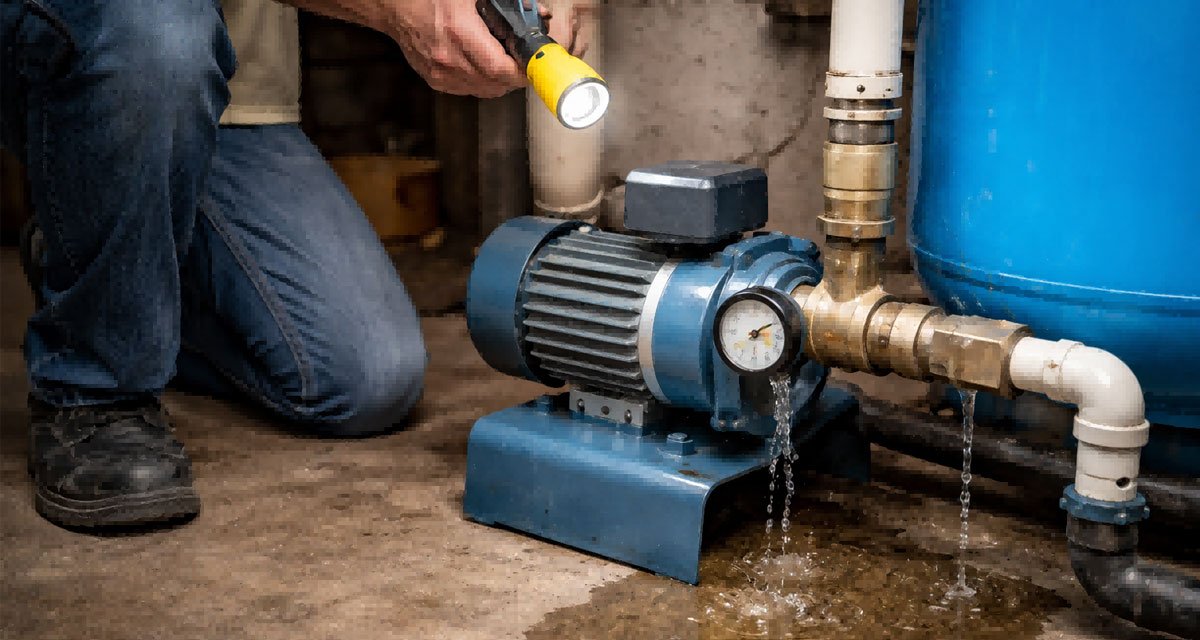
If the pressure falls after the pump shuts off and every faucet is closed, water is going somewhere. The leak may be in the house, underground, inside the well casing, or backward through a failed check valve.
This is the cycling pattern that deserves a slower, more suspicious look. The house can seem quiet, the floor can be dry, and the gauge can still bleed down every few minutes.
| Symptom | Possible cause | What to do next |
|---|---|---|
| Pressure drops with all valves closed | Hidden leak or failed check valve | Shut off the house supply valve and watch the gauge |
| Pressure holds when house valve is closed | Leak is likely in house plumbing or fixtures | Check toilets, softeners, filters, hose bibs, and irrigation |
| Pressure still drops when house valve is closed | Issue may be between tank and well | Call a well contractor for drop pipe and check valve testing |
| Air spurts at faucets after cycling | Well-side leak, low water level, or suction problem | Stop heavy use and get the well side inspected |
Toilets deserve a mention because they are boring and sneaky. A flapper leaking into the bowl can make a well system cycle at night, and the only sound may be a faint refill hiss every now and then.
The Pump and Tank May Be Mismatched
A pump can cycle too often even when every part is technically working if the tank is too small for the pump output. The pump fills the tank quickly, shuts off quickly, and then restarts as soon as demand pulls pressure down.
This often shows up after a pump replacement, pressure tank replacement, irrigation change, or remodel. On paper the system works; in practice it hammers the switch and motor with too many starts.
The useful number is drawdown, which means the amount of water the tank can deliver between pump starts. A large tank does not mean large drawdown, because the pressure setting and tank design matter.
- A higher pressure range usually reduces usable drawdown.
- A larger pump usually needs more tank drawdown to avoid short cycling.
- Irrigation zones should be matched to pump flow, not guessed from lawn size.
- Constant pressure systems use different controls and should be diagnosed by their own manual.
If the cycling began right after equipment was changed, do not chase random leaks first. Ask for the pump flow rate, tank drawdown, and pressure switch setting to be checked as one system.
What to Check First, in the Right Order
The safest order is to separate demand, storage, control, and leakage. That keeps you from replacing a pump when the real failure is a tank bladder or a five-dollar pressure gauge.
Start with observation, then move to simple isolation tests. Stop if you smell burning, see arcing at the switch, lose all water pressure, or are not comfortable working around 120 or 240 volt equipment.
- Turn off sprinklers, washers, softener regeneration, and all fixtures.
- Watch the pressure gauge for 10 to 20 minutes with no water running.
- If pressure drops, isolate the house with the main shutoff valve.
- If pressure holds, check house fixtures and appliances for leaks.
- If pressure still drops, suspect a well-side leak or check valve.
- Turn pump power off, drain the tank, and measure tank air precharge.
- Check for water at the tank air valve.
- Inspect the pressure switch, switch nipple, and gauge condition.
Not glamorous. Effective.
Keep a quick note of the pressure readings and cycle timing. A contractor can do more with “cuts in at 31, cuts out at 51, drops to 31 in four minutes with the house valve closed” than with “it keeps running weird.”
When to Shut It Down and Call a Well Pro
Call a well contractor or licensed plumber when the pump is clicking rapidly, the pressure falls with the house isolated, water comes from the tank air valve, or the pressure switch shows arcing or heat damage. Those signs point beyond routine homeowner adjustment.
Short cycling is not just annoying. The motor starts under high electrical load each time, and repeated starts are harder on the pump than steady running.
You should also get help if the system involves a submersible pump, buried lines, a pitless adapter, a low-yield well, or a constant-pressure controller. Pulling a pump or diagnosing a down-well check valve is a different job from adding air to a tank.
There is one more practical reason to move quickly: a failing tank can turn a small service call into a pump replacement if the system keeps hammering itself for weeks. The pressure switch clicks sound tiny, but they are counting.
FAQ
Is it bad if my well pump keeps cycling?
Yes, rapid cycling is bad for a well pump because repeated starts heat and stress the motor, contacts, and pressure controls. Normal cycling during water use is different from short cycling every few seconds.
Why does my well pump keep cycling after it reaches pressure?
A well pump that reaches shutoff pressure and then cycles again is losing pressure somewhere. The most likely causes are a leaking fixture, a failed check valve, a damaged drop pipe, or a pressure tank that no longer holds enough air cushion.
Why does my well pump cycle when no water is running?
A well pump cycling with no water running usually means pressure is leaking away through a fixture, pipe, pressure tank problem, or check valve. Close the house shutoff valve and watch whether the pressure still falls.
How often should a well pump cycle?
There is no single perfect interval, but a pump should generally run long enough to refill the tank smoothly rather than clicking on and off every few seconds. Under steady water use, cycling depends on pump flow, tank drawdown, and demand.
Can I add air to my pressure tank?
You can add air to many bladder-style pressure tanks after turning off power and draining water pressure to zero. Set the empty tank precharge about 2 psi below the switch cut-in pressure, unless the tank manufacturer specifies otherwise.
Does short cycling mean I need a new pump?
Not usually. Short cycling more often points to the pressure tank, pressure switch, air charge, leaks, or check valve before it points to the pump itself.
Final Check Before You Replace Anything
If your well pump keeps cycling, do not start with the most expensive part. Start with the cycle pattern, then the pressure tank, then the switch, then leakage and check-valve behavior.
The best first answer is usually found on the pressure gauge. Watch what the system does with water running, then with everything off, and the problem often stops being mysterious.
If the pump is short cycling fast, shut the power off and diagnose it before more starts pile up. A quiet tank and a steady gauge are cheaper than a burned pump.