



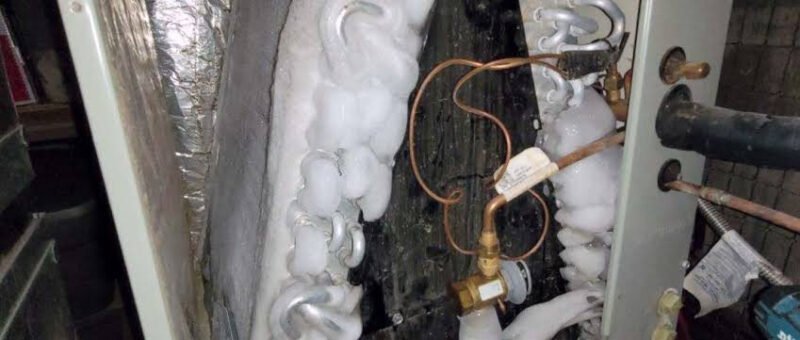
An air conditioner refrigerant line that is frozen is a different problem from a frozen evaporator coil, and it is more dangerous for the compressor. The line in question is the larger of the two copper pipes at the outdoor unit, the suction line. It is covered with black foam insulation. It carries cold refrigerant gas from the indoor evaporator coil back to the compressor. Under normal conditions, the suction line is cold and sweating, roughly 40 to 50 degrees. When it freezes, ice forming on the outside of the pipe, the refrigerant inside is colder than 32 degrees. Liquid refrigerant is returning to the compressor. A compressor is designed to compress gas, not liquid. Liquid refrigerant entering the compressor is called floodback or slugging, and it can destroy the compressor in minutes.
The smaller copper pipe, the liquid line, should be warm, roughly 100 to 110 degrees. It carries warm liquid refrigerant from the outdoor condenser to the indoor coil. If the small line is frozen, which is rare, there is a restriction in the liquid line that is causing the refrigerant to expand and freeze at that point. More commonly, if both lines are cold, the system is so low on refrigerant that the entire system is running at a depressed temperature and pressure. The suction line ice is the most common and the most dangerous. The liquid line ice is less common and indicates a different problem. The location of the ice tells you what is wrong.
EPA WaterSense advises that maintaining equipment prevents failures. A frozen suction line is an urgent condition that can lead to compressor failure. Turn the AC off immediately if you see ice on the refrigerant lines.
Ice on the Large Suction Line: Liquid Floodback
The suction line is the larger of the two copper pipes. It is the one with the black foam insulation. The insulation keeps it from sweating on your floor or in your walls. It also keeps it from absorbing heat from the surrounding air, which helps the refrigerant return to the compressor as a cool gas rather than a warm gas. When ice forms on the suction line, starting at the outdoor unit and spreading toward the indoor unit, the refrigerant is not fully evaporating in the indoor coil. Liquid refrigerant is leaving the coil and traveling through the suction line. The liquid continues to evaporate in the suction line, absorbing heat from the pipe and the air around it, and freezing the condensation on the outside of the pipe.
The most common cause of floodback is low refrigerant charge. There is not enough refrigerant in the system to absorb a full heat load in the evaporator coil. The refrigerant evaporates completely before reaching the end of the coil, and the remaining portion of the coil, and the suction line, contain a mixture of liquid and gas that is below freezing. A dirty air filter causing severely restricted airflow can also cause floodback. The coil is so starved of heat that the refrigerant barely evaporates at all. A failed blower motor, no airflow at all, causes immediate floodback and freeze. A sticking metering device that is flooding the coil with too much refrigerant can also cause liquid to leave the coil.
Turn the AC off immediately if you see ice on the suction line. Let the ice melt completely. Check the filter. Replace it if dirty. Restart the system and watch the suction line. If ice begins to form again within minutes, the system is low on refrigerant or has a metering device problem. Call a technician. Continuing to run the AC with floodback will destroy the compressor. The compressor replacement costs $1,500 to $3,500. The diagnosis and refrigerant repair costs $300 to $1,500. The math favors turning it off.
Ice on the Small Liquid Line: A Restriction
The liquid line is the smaller uninsulated copper pipe. It carries warm liquid refrigerant from the outdoor unit to the indoor coil. Ice on the liquid line is uncommon and indicates a restriction at the point where the ice begins. The restriction could be a clogged filter drier, a kinked pipe, or debris in the liquid line. The refrigerant, which is a high-pressure liquid upstream of the restriction, expands to a low-pressure liquid-gas mixture downstream of the restriction. The expansion causes the temperature to drop below freezing. The ice forms on the downstream side of the restriction.
Locate the point where the ice begins. The restriction is at that point. A common location is the filter drier, a cylindrical component in the liquid line near the outdoor unit or the indoor coil. The filter drier removes moisture and debris from the refrigerant. Over time, it can become clogged, especially if the system has experienced a compressor burnout that released debris into the refrigerant. A restricted filter drier must be replaced by a technician. The repair involves recovering the refrigerant, cutting out the old drier, brazing in a new one, evacuating the system, and recharging it. The cost is $300 to $800. The restriction may also be caused by the metering device if it is a fixed orifice that is clogged, though this more commonly causes ice on the indoor coil rather than on the liquid line.
Both Lines Cold: Severe Undercharge
If both the suction line and the liquid line are cold, and the suction line may be frozen while the liquid line is just cold, the system is severely undercharged. There is so little refrigerant in the system that the entire refrigeration cycle is operating at a depressed temperature and pressure. The compressor is running, but the pressures on both sides of the system are low. The air from the registers will be barely cool. The system may be making little or no cooling. The outdoor unit may be running but the compressor may be unusually quiet because it is not working against a normal pressure differential.
A severely undercharged system must not be run. Turn it off. Call a technician. The leak must be located and repaired before the system can be recharged. Continuing to run a severely undercharged AC can damage the compressor because the compressor relies on the returning suction gas to cool its motor windings. With very low suction pressure, there is not enough gas flow to cool the compressor. The motor overheats and the windings fail.
Frequently Asked Questions
Does the insulation on the suction line cause it to freeze?
No. The insulation is there to prevent condensation and to keep the suction gas cool. If the insulation is missing or damaged, the suction line will sweat and drip water, which can look like a leak but is normal condensation. If the insulation is missing and the suction line is freezing, the underlying problem is floodback, not the missing insulation. The insulation keeps the line from sweating. It does not cause freezing.
Why is only part of the suction line frozen?
The ice starts at the outdoor unit and spreads toward the indoor unit as the floodback condition worsens. A partially frozen line, ice only near the outdoor unit, is an early stage of floodback. The liquid refrigerant is evaporating in the last few feet of the suction line before it reaches the compressor. As the condition worsens, the ice spreads farther toward the indoor unit. A partially frozen line is still floodback. Turn the system off and diagnose the cause.
Is it normal for the lines to freeze on a heat pump in winter?
The outdoor coil on a heat pump will frost and freeze in winter. The heat pump periodically runs a defrost cycle to melt the ice. The refrigerant lines to the indoor unit, the larger line especially, may be cold but should not be frozen solid. Ice on the indoor refrigerant lines in winter is not normal and indicates a problem similar to floodback in cooling mode, except it is occurring in heating mode. Call a technician.
The Bottom Line
A frozen AC refrigerant line, specifically the large suction line, means liquid refrigerant is returning to the compressor. Turn the system off immediately. Let the ice melt. Check the filter. If the filter is clean and the line freezes again, call a technician. The cause is low refrigerant, restricted airflow, or a failing metering device. Running the AC with a frozen suction line will destroy the compressor. The cost of turning it off is zero. The cost of running it until the compressor fails is thousands. The ice on the line is a warning. Heed it.