



If you searched for how to install HardieBacker siding, you are probably looking for one of two things. You either want to install James Hardie fiber cement siding on the outside of your house, in which case you want HardiePlank or HardiePanel, not HardieBacker. Or you are installing tile in a bathroom or kitchen and need to know how to install the cement backer board that goes under the tile. HardieBacker is a cement backer board for interior tile installations. It is not siding. It is not rated for exterior use. It is not designed to be exposed to weather. Installing HardieBacker on the outside of a house will result in a wall that absorbs water, freezes, and fails within a single winter. This guide explains what HardieBacker is, how to install it correctly for its intended purpose, and what product you actually need if you are looking for exterior siding.
James Hardie manufactures two completely separate product lines that share the Hardie name and the fiber cement material but are designed for entirely different applications. HardieBacker is a cement board for interior wet areas, used as a substrate under ceramic, porcelain, or stone tile. HardiePlank, HardiePanel, HardieShingle, and HardieSoffit are exterior siding products. The material is similar, cement, sand, and cellulose fibers, but the formulation, the density, the surface treatment, and the installation requirements are different. HardieBacker is not a siding product. Using it as siding will fail.
What HardieBacker Actually Is
HardieBacker is a cement backer board, sometimes called cement board or backer board, used as a tile underlayment. It is installed on floors and walls in bathrooms, kitchens, laundry rooms, and any interior area where tile will be exposed to moisture. The board is half-inch or quarter-inch thick, available in three-foot-by-five-foot sheets, and is cut by scoring with a utility knife and snapping along the score line. It is fastened to wood subfloors or wall studs with corrosion-resistant screws. The seams between sheets are taped with alkali-resistant mesh tape and covered with thinset mortar. Tile is then installed over the HardieBacker using thinset mortar.
HardieBacker is not waterproof. It is water-resistant. It does not degrade when exposed to moisture the way drywall or plywood does, but it does absorb water. In a shower, the HardieBacker is covered with a waterproof membrane or a liquid-applied waterproofing before tile is installed. The board itself is the stable substrate. The waterproofing is a separate layer. HardieBacker installed on an exterior wall would absorb rainwater, freeze, and spall, shedding layers of the board as the trapped water expands into ice. It is not designed for exterior exposure.
How to Install HardieBacker for Tile
On floors, HardieBacker is installed over a plywood or OSB subfloor. The subfloor must be structurally sound and meet the deflection requirements for the tile being installed. Spread a layer of thinset mortar on the subfloor using a quarter-inch notched trowel. Place the HardieBacker sheet into the wet mortar. The mortar fills any voids between the subfloor and the backer board, providing full support. Fasten the sheet with one-and-five-eighth-inch corrosion-resistant backer board screws every eight inches along the edges and in the field. Stagger the joints between sheets so no four corners meet at a single point. Leave a one-eighth-inch gap between sheets for expansion. Tape the joints with alkali-resistant mesh tape embedded in thinset mortar.
On walls, HardieBacker is fastened directly to wood or metal studs spaced 16 inches on center. The sheets are installed horizontally or vertically with the seams staggered from the framing seams if possible. Fasten with one-and-five-eighth-inch backer board screws every eight inches. Leave a one-eighth-inch gap between sheets. Tape the joints. Apply a waterproof membrane or liquid waterproofing before tiling in wet areas.
What to Use Instead: Hardie Siding Products
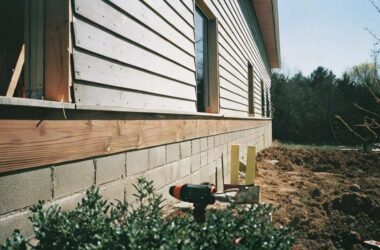
If you are looking for exterior siding, the James Hardie products you want are HardiePlank lap siding, HardiePanel vertical siding, HardieShingle siding, HardieSoffit for eaves, and HardieTrim for corner boards and window trim. These products are specifically engineered for exterior exposure. They are installed over a water-resistive barrier with specific clearances, gaps, and fasteners. They are painted or factory-finished to protect them from weather. The installation is fundamentally different from HardieBacker installation.
HardiePlank lap siding is the most common exterior Hardie product. It is installed horizontally, blind-nailed through the top edge, with a minimum one-and-a-quarter-inch overlap. HardiePanel is installed vertically with battens over the seams. HardieShingle is face-nailed in courses. All exterior Hardie products require corrosion-resistant fasteners, a minimum clearance above grade of six to eight inches depending on climate zone, one-eighth-inch gaps at all trim and butt joints, and flashing at all openings. The installation details are covered in separate guides for each product. The key point is that HardieBacker is not one of these products.
Frequently Asked Questions
Can HardieBacker be used as exterior siding?
No. HardieBacker is a tile backer board for interior use. It is not rated for exterior exposure, does not have the required weather resistance, and will fail if installed on the outside of a house. Use HardiePlank, HardiePanel, or HardieShingle for exterior siding.
How do I tell HardieBacker apart from Hardie siding?
HardieBacker is sold in three-foot-by-five-foot sheets, a half-inch or quarter-inch thick, with a smooth grey surface and a grid pattern printed on one side. HardiePlank siding is sold in long narrow planks, typically 12 feet long and four to 12 inches wide, with a wood-grain or smooth texture. The packaging is clearly labeled. HardieBacker says “Cement Backer Board” on the wrapper. HardiePlank says “Lap Siding.”
Can I use HardieBacker for an outdoor tile installation?
HardieBacker can be used as a tile substrate in protected outdoor areas that are not exposed to direct weather, such as a covered porch with a roof. It cannot be used in areas exposed to rain, snow, or freeze-thaw cycles. For exterior tile installations exposed to weather, use a cement backer board specifically rated for exterior use, or a mortar bed over a waterproof membrane.
The Bottom Line
HardieBacker is cement board for tile. HardiePlank and HardiePanel are cement siding for houses. The names are similar. The products are not interchangeable. If you searched for HardieBacker siding because you want to put siding on your house, buy HardiePlank or HardiePanel. If you are tiling a bathroom, buy HardieBacker. The product you need is determined by the project you are doing. The project you are doing is determined by whether you are inside the house or outside it.